DOCUMENTED BY BATCH
Identity (HPLC)
High-performance liquid chromatography records the compound’s retention profile against a reference.
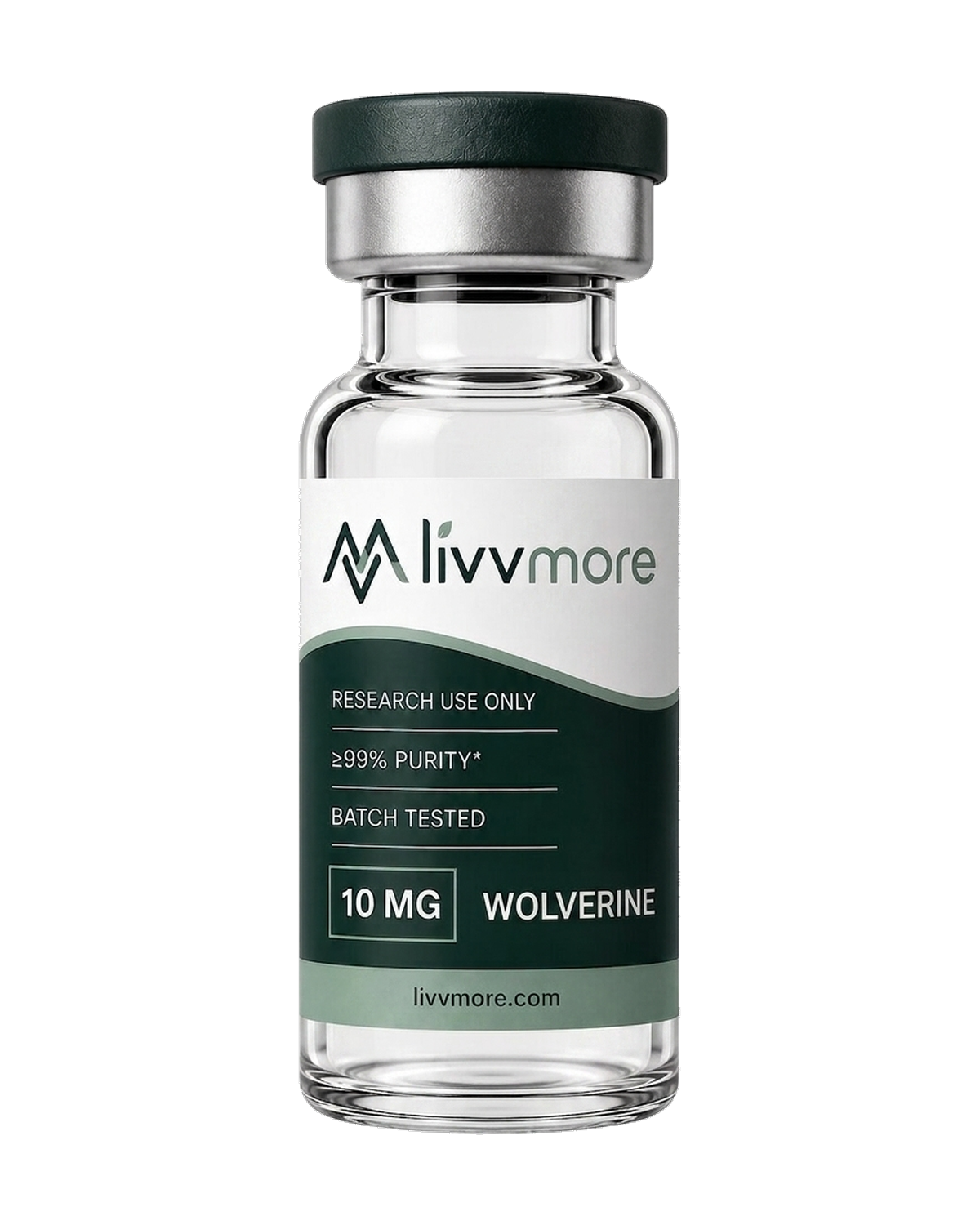
Research peptide
Lyophilized powder, catalogued by compound identity and backed by a certificate of analysis for its production batch.
Indicative · checkout opens at launch
100 in stock
Sealed, labelled vials · US delivery
| Quantity | 5–9 | 10+ |
|---|---|---|
| Discount | 10% | 15% |
| Price | $117.00 | $110.50 |
Indicative volume pricing, confirmed at launch.
View specifications Batch documentation Certificate of analysis
Documented by batch
Overview
A two-component peptide blend for scientific and laboratory investigation.
BPC-157 + TB-500 is a co-formulated research product containing two chemically distinct investigational peptides. BPC-157 is a synthetic 15-amino-acid pentadecapeptide associated with a body of preclinical research involving gastrointestinal, musculoskeletal, vascular and neural models. TB-500 is a synthetic seven-amino-acid peptide related to the central actin-binding region of thymosin beta-4. The blend is best described as two co-formulated research peptides rather than as a single molecule or an established, validated combination.
The two components differ in sequence, molecular mass, proposed biological activity and evidence base. BPC-157 research has focused primarily on experimental cytoprotection, gastrointestinal tissue biology, angiogenic signalling, nitric-oxide pathways and connective-tissue models. Research involving thymosin beta-4 and related fragments has focused on actin dynamics, cell migration, angiogenesis, immune-related signalling and tissue-remodelling biology. These areas overlap conceptually, but overlap does not establish that the exact BPC-157 + TB-500 combination produces additive or synergistic effects.
A central factual distinction is that TB-500 is not synonymous with full-length thymosin beta-4. Native thymosin beta-4 is a 43-amino-acid intracellular peptide and a major actin-sequestering protein. The FDA’s 2026 scientific review describes TB-500-related substances as seven-amino-acid peptides. Much of the published literature often cited in commercial descriptions concerns full-length thymosin beta-4, not the shorter TB-500 substance. Findings from thymosin beta-4 studies should therefore not be presented as direct evidence for TB-500 unless the tested material was specifically identified as TB-500.
BPC-157 has been investigated for several decades, but the evidence base remains dominated by animal and laboratory research. Published reviews describe experimental findings in tendon, ligament, skeletal-tissue, bone, peripheral-nerve and gastrointestinal models. These studies provide mechanistic and hypothesis-generating information, but they do not establish activity in humans. Human research remains limited, and no drug approved by the FDA contains BPC-157.
The BPC-157 literature has examined cellular migration, fibroblast activity, extracellular-matrix organisation, collagen-related processes, vascular responses and nitric-oxide-associated signalling. Results vary by model and experimental design. The mechanisms proposed in the literature remain incompletely resolved, and findings from rodents or isolated cells cannot automatically be extrapolated to human physiology.
Thymosin beta-4 is naturally present in many mammalian tissues and has been widely studied as an actin-binding peptide involved in cell motility and tissue-remodelling responses. Research has examined dermal and corneal wound models, angiogenesis, immune-related signalling and cardiac or vascular injury. Small human studies have also evaluated formulated thymosin beta-4 products in specific topical or ophthalmic research settings. These studies relate to defined thymosin beta-4 formulations and should not be used to imply that a laboratory TB-500 product has equivalent composition, pharmacology, safety or activity.
TB-500 is commonly marketed as a thymosin beta-4-derived peptide, but the precise commercial identity of products sold under the TB-500 name has not always been described consistently. For that reason, the product page and Certificate of Analysis state the exact sequence, salt form, molecular mass and quantity of the TB-500 component, and generic references to thymosin beta-4 are avoided unless the supplied compound is the full-length 43-amino-acid peptide.
The scientific rationale for studying BPC-157 and TB-500 together is based on the possibility that the components may influence different aspects of tissue biology. BPC-157 research frequently examines signalling and vascular responses, while thymosin beta-4-related research frequently examines actin dynamics and cellular migration. This rationale is theoretical for the exact blend, and high-quality peer-reviewed studies directly evaluating a co-formulated BPC-157 + TB-500 product are lacking.
Wolverine is an optional secondary product name rather than a scientific identity. For scientific and search clarity, the factual identity is BPC-157 + TB-500, a co-formulated research peptide blend.
Musculoskeletal research represents one of the most frequently discussed areas for both components. Experimental BPC-157 studies have evaluated tendon-to-bone interfaces, tendon fibroblasts, skeletal-tissue and ligament models. Thymosin beta-4 studies have assessed actin-mediated cell migration, tissue remodelling and wound-model biology. The existing literature does not establish tissue-level activity of the combined blend in humans, and the page avoids outcome claims relating to human tendons, ligaments or connective tissue.
Angiogenesis and vascular biology are additional areas of scientific interest. BPC-157 studies have reported effects involving endothelial behaviour and nitric-oxide-associated pathways in experimental systems. Thymosin beta-4 research has examined endothelial migration, blood-vessel formation and tissue responses following injury. Angiogenesis is biologically complex and can be favourable or undesirable depending on context, so it should not be described as universally favourable.
The two compounds also differ in their available safety information. The FDA has stated that compounded BPC-157 may present immunogenicity risks and challenges involving peptide-related impurities and active-ingredient characterisation. The FDA has also stated that it lacks sufficient safety information to determine whether BPC-157 would cause harm in humans by the proposed exposure routes. A 2026 FDA review of TB-500 found insufficient nonclinical pharmacology supporting the proposed wound-related use and no identified nonclinical toxicity studies for the nominated TB-500 substances.
The FDA’s 2026 briefing materials also described an adverse-event report involving a product labelled BPC-157 and TB-500. A single report cannot establish causation, but it reinforces that the safety of the combined formulation has not been established and that a research-use label should not be interpreted as evidence of safety for self-directed use.
Neither BPC-157 nor TB-500 is a drug approved by the FDA. The fact that related substances are discussed by the FDA Pharmacy Compounding Advisory Committee does not represent approval, sponsorship or confirmation of safety and effectiveness. The livvmore product must not be described as an approved drug, a compounded prescription product or a substitute for any approved product.
Both compounds are also relevant to anti-doping regulation. The 2026 World Anti-Doping Agency Prohibited List includes BPC-157 within the category of non-approved substances and identifies TB-500 among prohibited growth-factor or growth-factor-modulating substances. Athletes and sporting participants should not interpret laboratory-research labelling as meaning the product is permitted in or out of competition.
At livvmore, BPC-157 + TB-500 is supplied exclusively for laboratory research and analytical investigation. Because the product contains two peptides, batch documentation verifies both identities independently. A single overall purity figure is not sufficient to confirm the identity, amount or ratio of each component.
Recommended batch documentation includes the sequence and molecular mass of each peptide, confirmation of the BPC-157 form, confirmation of the precise TB-500 sequence, the amount of each component, the blend ratio, chromatographic data, mass-spectrometric identity and batch traceability. Any product-specific purity, appearance or storage statement should match the current batch Certificate of Analysis and validated laboratory procedures.
For laboratory research use only. Not for human or veterinary use.
Specifications
Batch documentation
Every batch is third-party tested. The batch-specific certificate of analysis is available on request; the layout below shows the fields it records.
Specimen layout. A batch-specific certificate of analysis is issued for each production run and is available on request.
Testing records
Every batch is accompanied by laboratory records. The entries below describe what each record documents.
High-performance liquid chromatography records the compound’s retention profile against a reference.
Mass spectrometry records the compound’s measured mass to document molecular identity.
The physical appearance of the material is recorded, for example a white lyophilized powder.
Each batch is logged with a lot number and production date for traceability.
These are records of laboratory testing carried out on the batch. They document compound identity for research use and are not a statement of safety, suitability, or fitness for any use.
Research information
BPC-157 and TB-500 are investigational peptides with separate molecular identities and different research histories. Their co-formulation is commercially common, but direct scientific evidence for the exact combination is limited. The available literature is therefore best interpreted component by component.
BPC-157 is a synthetic pentadecapeptide. TB-500-related substances evaluated by the FDA are seven-amino-acid peptides derived from a region of thymosin beta-4, while full-length thymosin beta-4 contains 43 amino acids. This difference is essential when evaluating references, because many frequently cited wound-related studies tested full-length thymosin beta-4 rather than TB-500.
Research on the two components spans several distinct areas. Most of it is preclinical, and each area is best interpreted in the context of the specific compound tested.
A two-peptide product requires methods capable of distinguishing both compounds. Documentation should identify separate chromatographic peaks where applicable, confirm molecular masses, verify the ratio and record the salt or counter-ion form. A combined assay result should not be used to imply that both components independently meet the same purity specification. Co-lyophilisation may also create analytical and stability considerations that require product-specific testing.
Recommended product and batch documentation includes:
BPC-157 has an extensive preclinical literature but minimal human evidence. Reviews published in 2019 and 2025 concluded that the available findings are predominantly derived from laboratory and animal research and that well-designed human trials are needed.
Thymosin beta-4 has a broader translational history than BPC-157, including preclinical work and small human investigations of defined topical or ophthalmic formulations. This evidence concerns full-length thymosin beta-4 and specific products, not necessarily TB-500.
The FDA’s 2026 evaluation found that nonclinical pharmacological evidence was lacking to support TB-500 for the proposed wound-related use and that nonclinical toxicology studies were not identified. This is more conservative than claims frequently made on commercial peptide websites.
Direct peer-reviewed research on the exact BPC-157 + TB-500 blend is sparse. There are no completed large randomised controlled trials establishing its activity or long-term safety. The blend remains an investigational laboratory product.
This information summarises findings from published scientific research and authoritative regulatory sources. It is provided solely for scientific, analytical and educational purposes.
The product page and Certificate of Analysis should clearly identify both peptide components, including the precise TB-500 sequence, the quantity of each peptide and the verified blend ratio.
For laboratory research use only. Not for human or veterinary use.
Frequently asked questions
Wolverine (BPC-157 + TB-500) is catalogued in the Co-formulated research peptides collection and supplied as a white lyophilized powder for in-vitro laboratory research. It is not for human or veterinary use.
Wolverine (BPC-157 + TB-500) is supplied as a white lyophilized powder. Store refrigerated at 2–8°C, protected from light and moisture. For extended storage, follow your laboratory's standard storage procedures.
All products are supplied strictly for in-vitro laboratory research and are not for human or veterinary use, diagnosis, treatment, or personal consumption.
Every batch is third-party tested and documented. The certificate of analysis is available on request.
Every batch is third-party tested, and the batch-specific certificate of analysis is available on request.
By placing an order, purchasers acknowledge that the product is intended solely for laboratory research use and agree to the Research Use Terms.
Fulfilment
Sealed, labelled research vials, packed to protect integrity in transit.
Every batch is third-party tested; the certificate of analysis is available on request.
Supplied to qualified researchers for laboratory research use.
Shipping options and timelines are shown at checkout.
More in this collection
Order
Indicative pricing · checkout opens at launch
Checkout opens at launch, once an approved payment provider is in place.
Every batch is checked against its compound identity before it is catalogued.
A US-based team on hand for catalogue, documentation and order questions.
Batch and lot records are kept for every compound, recorded not asserted.
Each batch is tested by an independent laboratory; the certificate is available on request.
Sealed, labelled research vials, packed to protect integrity in transit.
Orders are prepared and dispatched promptly.