DOCUMENTED BY BATCH
Identity (HPLC)
High-performance liquid chromatography records the compound’s retention profile against a reference.
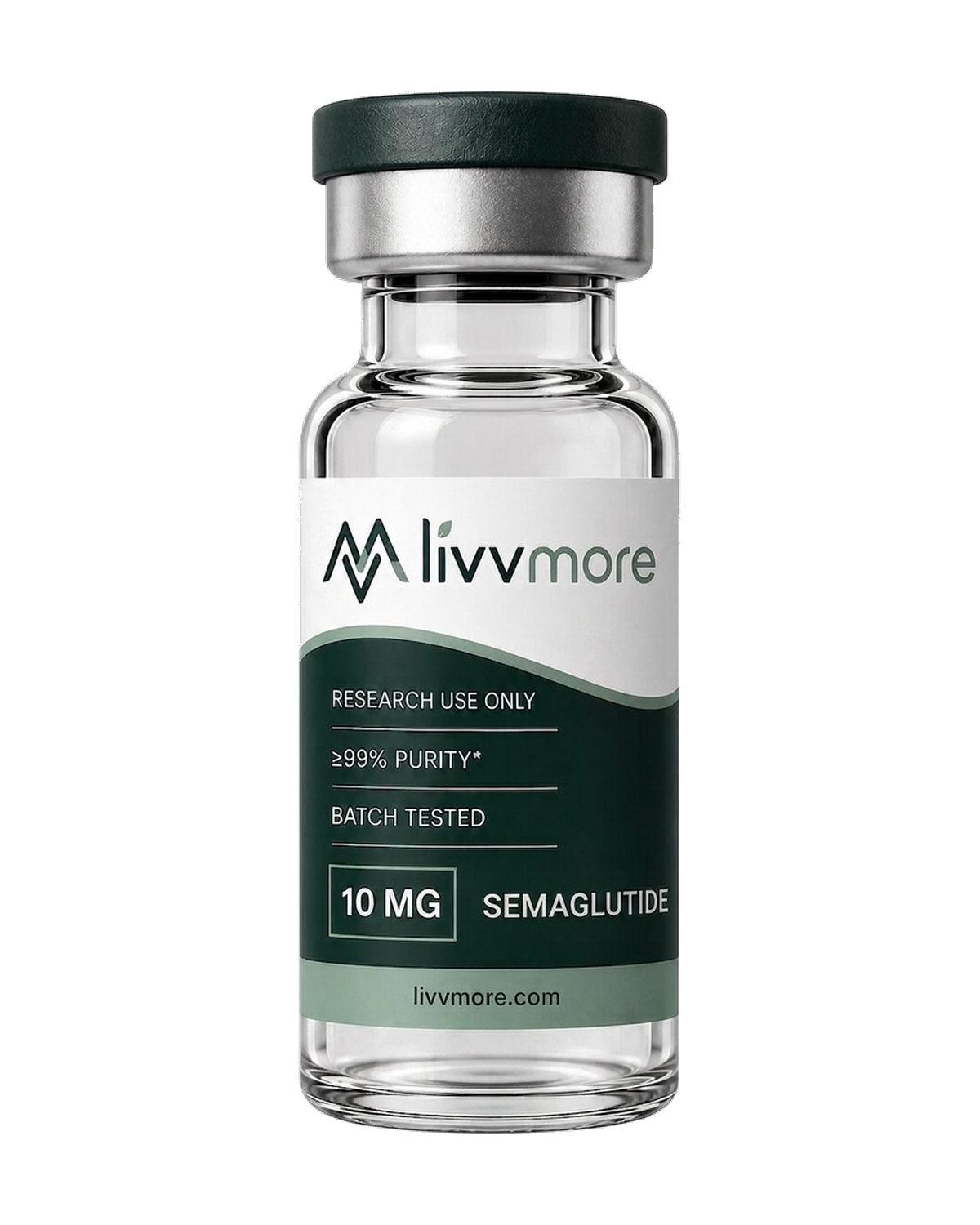
Research peptide
Lyophilized powder, catalogued by compound identity and backed by a certificate of analysis for its production batch.
Indicative · checkout opens at launch
100 in stock
Sealed, labelled vials · US delivery
| Quantity | 5–9 | 10+ |
|---|---|---|
| Discount | 10% | 15% |
| Price | $108.00 | $102.00 |
Indicative volume pricing, confirmed at launch.
View specifications Batch documentation Certificate of analysis
Documented by batch
Overview
Semaglutide is a synthetic glucagon-like peptide-1 (GLP-1) receptor agonist that has become one of the most extensively studied peptide compounds in modern metabolic and endocrine research. Originally developed as a long-acting analogue of the naturally occurring incretin peptide GLP-1, Semaglutide has attracted significant scientific interest because of its prolonged receptor activity, structural stability, and its utility as a research tool for investigating metabolic signalling, endocrine signalling, gastrointestinal physiology, pancreatic β-cell biology, energy metabolism, and peptide receptor pharmacology.
Within the scientific community, GLP-1 receptor agonists have become an important area of investigation due to their role in regulating numerous physiological signalling pathways. Semaglutide has become one of the most frequently referenced compounds in this class because of its well-characterised molecular structure, extensive peer-reviewed literature, and broad application across laboratory-based metabolic research. Researchers continue to investigate Semaglutide in experimental models designed to improve the understanding of incretin biology, receptor activation, intracellular signalling, peptide secretion, cellular communication, and metabolic regulation.
Semaglutide is a modified peptide analogue based on endogenous human GLP-1. Structural modifications were introduced to improve enzymatic stability and prolong biological activity within experimental settings. These molecular modifications distinguish Semaglutide from native GLP-1 and have made it an important compound for studying sustained GLP-1 receptor activation. Its molecular characteristics have also contributed to its widespread use in basic science, translational research, and pharmaceutical development programmes investigating metabolic physiology and peptide pharmacology.
One of the defining characteristics of Semaglutide is its molecular design. Through selective amino acid substitution and attachment of a fatty diacid side chain via an appropriate linker molecule, Semaglutide demonstrates increased affinity for serum albumin and enhanced resistance to degradation by DPP-4. These structural modifications have been extensively described within the scientific literature and form an important area of biochemical investigation.
The expanding body of published research surrounding Semaglutide reflects the rapid development of incretin-based science over the past decade. Investigations now extend beyond receptor pharmacology to encompass molecular signalling pathways, endocrine communication, gastrointestinal peptide biology, adipose tissue physiology, pancreatic function, nutrient sensing, and energy homeostasis. As these areas continue to develop, Semaglutide remains one of the most widely utilised GLP-1 receptor agonists within laboratory research.
Scientific investigations involving Semaglutide frequently explore the physiological role of incretin peptides within the endocrine system. Researchers continue studying receptor activation, intracellular signalling, peptide engineering, cellular communication, and systems biology across endocrinology, pharmacology, physiology, structural biology, and translational research.
The glucagon-like peptide-1 receptor belongs to the class B family of G protein-coupled receptors (GPCRs), which play a central role in cellular communication. Activation of this receptor initiates complex intracellular signalling cascades involving cyclic adenosine monophosphate (cAMP), protein kinase A (PKA), exchange proteins directly activated by cAMP (EPAC), calcium signalling pathways, and downstream transcriptional responses.
At livvmore, Semaglutide is supplied exclusively as a research peptide for laboratory and scientific investigation. Every batch is manufactured for research purposes and undergoes quality control procedures designed to verify identity, purity, and consistency before release. Batch-specific documentation, including Certificates of Analysis (COA), supports researchers requiring consistent peptide materials for laboratory investigations.
livvmore is committed to supplying research peptides that support scientific investigation through consistent manufacturing standards, rigorous quality assurance procedures, and transparent documentation.
For laboratory research use only. Not for human or veterinary use.
Specifications
Batch documentation
Every batch is third-party tested. The batch-specific certificate of analysis is available on request; the layout below shows the fields it records.
Specimen layout. A batch-specific certificate of analysis is issued for each production run and is available on request.
Testing records
Every batch is accompanied by laboratory records. The entries below describe what each record documents.
High-performance liquid chromatography records the compound’s retention profile against a reference.
Mass spectrometry records the compound’s measured mass to document molecular identity.
The physical appearance of the material is recorded, for example a white lyophilized powder.
Each batch is logged with a lot number and production date for traceability.
These are records of laboratory testing carried out on the batch. They document compound identity for research use and are not a statement of safety, suitability, or fitness for any use.
Research information
Semaglutide is a synthetic glucagon-like peptide-1 (GLP-1) receptor agonist that has become one of the most extensively investigated peptide compounds in contemporary metabolic and endocrine research. Its molecular structure, receptor pharmacology, cellular signalling pathways, and physiological interactions have been widely described in peer-reviewed scientific literature.
Semaglutide was developed as a long-acting analogue of endogenous GLP-1 through structural modifications that increase resistance to enzymatic degradation by DPP-4 and enhance albumin binding. These molecular characteristics have made it an important compound for laboratory investigations into peptide chemistry and receptor biology.
The GLP-1 receptor belongs to the Class B family of G protein-coupled receptors (GPCRs). Activation of this receptor initiates intracellular signalling through cyclic AMP (cAMP), protein kinase A (PKA), EPAC proteins, and calcium-mediated signalling pathways. These signalling mechanisms remain active areas of scientific investigation.
This information summarises findings from the peer-reviewed scientific literature and is provided for educational and laboratory research purposes only. livvmore supplies Semaglutide exclusively for laboratory research use.
For laboratory research use only. Not for human or veterinary use.
Frequently asked questions
Semaglutide is catalogued in the GLP research peptides collection and supplied as a white lyophilized powder for in-vitro laboratory research. It is listed by CAS number 910463-68-2 and a molecular weight of 4113.58 g/mol. It is not for human or veterinary use.
The CAS number recorded for Semaglutide is 910463-68-2.
The molecular weight recorded for Semaglutide is 4113.58 g/mol.
Semaglutide is supplied as a white lyophilized powder. Store refrigerated at 2–8°C, protected from light and moisture. For extended storage, follow your laboratory's standard storage procedures.
All products are supplied strictly for in-vitro laboratory research and are not for human or veterinary use, diagnosis, treatment, or personal consumption.
Every batch is third-party tested and documented. The certificate of analysis is available on request.
Every batch is third-party tested, and the batch-specific certificate of analysis is available on request.
By placing an order, purchasers acknowledge that the product is intended solely for laboratory research use and agree to the Research Use Terms.
Fulfilment
Sealed, labelled research vials, packed to protect integrity in transit.
Every batch is third-party tested; the certificate of analysis is available on request.
Supplied to qualified researchers for laboratory research use.
Shipping options and timelines are shown at checkout.
Order
Indicative pricing · checkout opens at launch
Checkout opens at launch, once an approved payment provider is in place.
Every batch is checked against its compound identity before it is catalogued.
A US-based team on hand for catalogue, documentation and order questions.
Batch and lot records are kept for every compound, recorded not asserted.
Each batch is tested by an independent laboratory; the certificate is available on request.
Sealed, labelled research vials, packed to protect integrity in transit.
Orders are prepared and dispatched promptly.