DOCUMENTED BY BATCH
Identity (HPLC)
High-performance liquid chromatography records the compound’s retention profile against a reference.
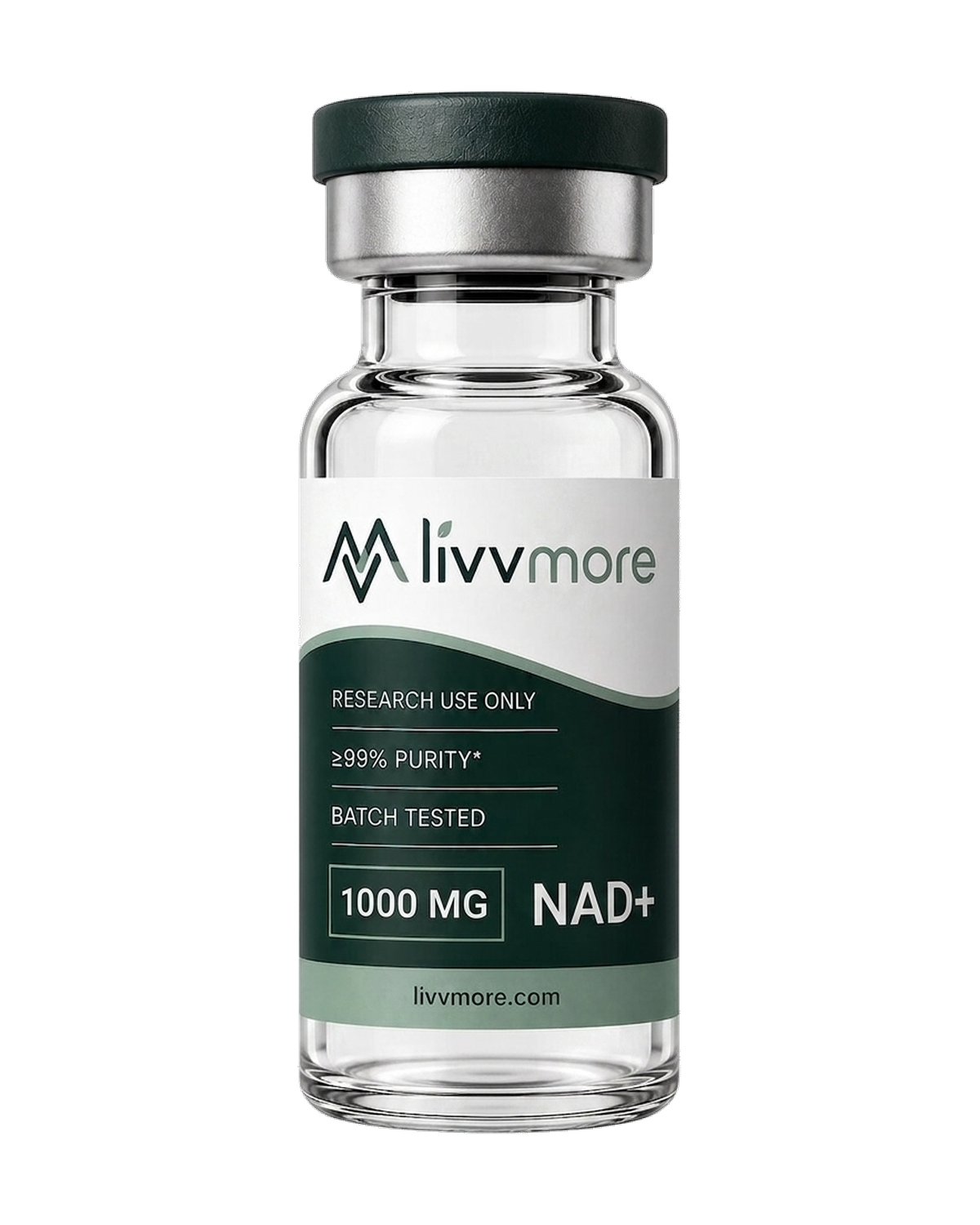
Research peptide
Lyophilized powder, catalogued by compound identity and backed by a certificate of analysis for its production batch.
Indicative · checkout opens at launch
100 in stock
Sealed, labelled vials · US delivery
| Quantity | 5–9 | 10+ |
|---|---|---|
| Discount | 10% | 15% |
| Price | $90.00 | $85.00 |
Indicative volume pricing, confirmed at launch.
View specifications Batch documentation Certificate of analysis
Documented by batch
Overview
Research grade NAD+ for scientific and laboratory research. Nicotinamide adenine dinucleotide (NAD+) is an essential coenzyme and metabolite present throughout living systems. It is not a peptide. Chemically, NAD+ is a dinucleotide composed of nicotinamide and adenine nucleotides linked through their phosphate groups. NAD+ participates in cellular energy metabolism, oxidation-reduction chemistry, DNA-damage responses and intracellular signalling, making it a major subject of investigation across biochemistry, molecular biology, mitochondrial research, metabolism, neuroscience and ageing biology.
NAD+ was identified during early twentieth-century investigations of fermentation and cellular respiration. Subsequent research established that it functions as an electron carrier by alternating between its oxidised form, NAD+, and its reduced form, NADH. In redox reactions, NAD+ accepts electrons and a proton to form NADH. NADH can then transfer reducing equivalents into pathways including mitochondrial electron transport, supporting the processes that generate adenosine triphosphate (ATP).
This NAD+/NADH redox pair is required for central metabolic pathways including central carbon metabolism, the tricarboxylic acid pathway and oxidative phosphorylation. NAD+ availability and the NAD+/NADH ratio influence metabolic flux, cellular redox state and the capacity of cells to respond to changing energy demand. NAD+ is compartmentalised among the cytosol, nucleus and mitochondria, and these pools are regulated through interconnected but distinct biosynthetic and consumption pathways.
The biological importance of NAD+ extends beyond redox metabolism. NAD+ is consumed as a substrate by several enzyme families, including sirtuins, poly(ADP-ribose) polymerases (PARPs), CD38 and related NADases. Unlike reversible redox interconversion between NAD+ and NADH, these reactions cleave NAD+ and therefore require continual resynthesis through de novo, Preiss-Handler and salvage pathways.
Sirtuins are NAD+-dependent protein deacylases that regulate diverse cellular processes. The seven mammalian sirtuins, SIRT1 through SIRT7, are distributed across the nucleus, cytosol and mitochondria. Experimental research examines their roles in gene regulation, mitochondrial function, metabolic adaptation, circadian biology and cellular stress responses. NAD+ availability can influence sirtuin activity, but changes in NAD+ do not necessarily produce uniform biological effects across tissues or experimental conditions.
PARP enzymes use NAD+ to transfer ADP-ribose units to target proteins during processes that include DNA-damage signalling and processing. PARP1 is activated in response to several forms of DNA damage. Sustained or excessive PARP activity can consume substantial amounts of NAD+, linking genomic stress to cellular energy metabolism. Researchers continue investigating how NAD+ availability, PARP activity and DNA-damage-response capacity interact under normal and pathological conditions.
CD38 is a multifunctional NAD+-consuming enzyme involved in the production of signalling molecules including cyclic ADP-ribose and ADP-ribose. These metabolites participate in calcium signalling and immune-cell biology. Animal and cellular studies implicate CD38 activity in age-associated changes in NAD+ metabolism, but the magnitude, timing and tissue distribution of age-related NAD+ changes in humans remain incompletely characterised.
Mitochondrial biology is one of the largest areas of NAD+ research. Mitochondria rely on NADH-derived reducing equivalents to support electron transport and ATP production. Experimental studies investigate how NAD+ metabolism relates to mitochondrial respiration, substrate oxidation, redox balance, mitochondrial biogenesis and cellular adaptation to energetic stress. Because NAD+ pools are compartmentalised, measurements from blood or one tissue cannot automatically be assumed to represent mitochondrial NAD+ availability in another tissue.
Ageing research has generated substantial interest in NAD+ metabolism. Many animal studies report declines in NAD+ availability with age in particular tissues and experimental conditions. Human data are more limited and tissue-specific, and current reviews caution against assuming that findings from rodents apply uniformly to people. Research continues to examine whether changes in NAD+ synthesis, consumption, compartmentalisation or precursor availability contribute to age-associated biological changes.
A major distinction is required between endogenous NAD+ biology, direct use of NAD+, and use of NAD+ precursors. Much of the human intervention literature evaluates precursors such as nicotinamide riboside (NR), nicotinamide mononucleotide (NMN), nicotinamide or nicotinic acid. These compounds enter NAD+ biosynthetic pathways but are not identical to NAD+ itself. Findings from precursor studies should not be represented as direct evidence for an NAD+ research product.
Systematic reviews of human research report that NAD+-raising interventions can alter NAD+-related biomarkers, particularly when precursor compounds are used. However, evidence for broad claims about ageing biology or general physiological outcomes remains inconclusive. Published evidence for direct exogenous NAD+ is substantially more limited than the literature on oral precursors, and available studies are generally small or exploratory.
Current NAD+ research spans cellular bioenergetics, mitochondrial function, metabolic regulation, DNA-damage responses, sirtuin biology, PARP signalling, CD38 activity, neurobiology, immune-cell metabolism, skeletal-tissue physiology and exercise adaptation. The breadth of these research areas reflects the central biochemical role of NAD+, but it does not mean that direct use of an NAD+ research product has been validated for each field.
At livvmore, NAD+ should be classified as a research coenzyme or laboratory research compound rather than a research peptide. Each production batch should be supported by product-specific analytical documentation. Appropriate documentation may include identity testing, purity analysis, assay or content measurement, water content where relevant, residual-solvent information and batch traceability. Product claims should match the results reported on the batch-specific Certificate of Analysis.
Researchers should consider the chemical form, salt form, purity, water content, storage conditions and analytical method when comparing NAD+ materials. A chromatographic purity percentage alone does not necessarily establish total assay, identity, stability or suitability for a particular experiment.
livvmore NAD+ is supplied exclusively for laboratory research and analytical investigation. Mechanistic findings involving endogenous NAD+, animal models or NAD+ precursors should not be interpreted as evidence of activity for this product.
For laboratory research use only. Not for human or veterinary use.
Specifications
Batch documentation
Every batch is third-party tested. The batch-specific certificate of analysis is available on request; the layout below shows the fields it records.
Specimen layout. A batch-specific certificate of analysis is issued for each production run and is available on request.
Testing records
Every batch is accompanied by laboratory records. The entries below describe what each record documents.
High-performance liquid chromatography records the compound’s retention profile against a reference.
Mass spectrometry records the compound’s measured mass to document molecular identity.
The physical appearance of the material is recorded, for example a white lyophilized powder.
Each batch is logged with a lot number and production date for traceability.
These are records of laboratory testing carried out on the batch. They document compound identity for research use and are not a statement of safety, suitability, or fitness for any use.
Research information
Nicotinamide adenine dinucleotide is both a redox coenzyme and a consumable substrate for signalling enzymes. This dual role places NAD+ at the intersection of cellular energy metabolism, mitochondrial function, genome maintenance and intracellular communication.
Interpretation of NAD+ research requires careful separation of four related but different subjects: endogenous NAD+ metabolism; experimental manipulation of NAD+ biosynthesis or consumption; use of NAD+ precursors; and direct use of NAD+ itself. Evidence from one category should not automatically be applied to another. This information is provided solely for scientific, analytical and educational purposes.
The mechanistic evidence establishing NAD+ as a central coenzyme and signalling substrate is extensive. Its roles in redox chemistry, mitochondrial metabolism, sirtuin activity, PARP reactions and CD38 biology are supported by a large body of biochemical, cellular and animal research.
Human intervention evidence is narrower. Most studies intended to raise NAD+ have used precursor compounds, particularly NR and NMN. These studies generally show that some precursors can increase NAD+-related metabolites, but physiological and experimental outcomes are inconsistent and often limited by small samples, short follow-up and varied study designs.
Evidence for direct exogenous NAD+ is substantially less developed. Recent systematic reviews identify very limited eligible human-study evidence for exogenous NAD+ itself and conclude that activity for broad ageing-biology or general physiological outcomes remains inconclusive.
The page should therefore avoid presenting established endogenous functions of NAD+ as proof that a research NAD+ product produces the same effects. It should also avoid transferring results from NR, NMN, nicotinamide or nicotinic acid studies directly to NAD+.
For laboratory research use only. Not for human or veterinary use.
Frequently asked questions
NAD+ is catalogued in the Other research compounds collection and supplied as a lyophilized powder for in-vitro laboratory research. It is listed by CAS number 53-84-9 and a molecular weight of 663.43 g/mol. It is not for human or veterinary use.
The CAS number recorded for NAD+ is 53-84-9.
The molecular weight recorded for NAD+ is 663.43 g/mol.
NAD+ is supplied as a lyophilized powder. Store refrigerated at 2–8°C, protected from light and moisture. For extended storage, follow your laboratory's standard storage procedures.
All products are supplied strictly for in-vitro laboratory research and are not for human or veterinary use, diagnosis, treatment, or personal consumption.
Every batch is third-party tested and documented. The certificate of analysis is available on request.
Every batch is third-party tested, and the batch-specific certificate of analysis is available on request.
By placing an order, purchasers acknowledge that the product is intended solely for laboratory research use and agree to the Research Use Terms.
Fulfilment
Sealed, labelled research vials, packed to protect integrity in transit.
Every batch is third-party tested; the certificate of analysis is available on request.
Supplied to qualified researchers for laboratory research use.
Shipping options and timelines are shown at checkout.
More in this collection
Order
Indicative pricing · checkout opens at launch
Checkout opens at launch, once an approved payment provider is in place.
Every batch is checked against its compound identity before it is catalogued.
A US-based team on hand for catalogue, documentation and order questions.
Batch and lot records are kept for every compound, recorded not asserted.
Each batch is tested by an independent laboratory; the certificate is available on request.
Sealed, labelled research vials, packed to protect integrity in transit.
Orders are prepared and dispatched promptly.