DOCUMENTED BY BATCH
Identity (HPLC)
High-performance liquid chromatography records the compound’s retention profile against a reference.
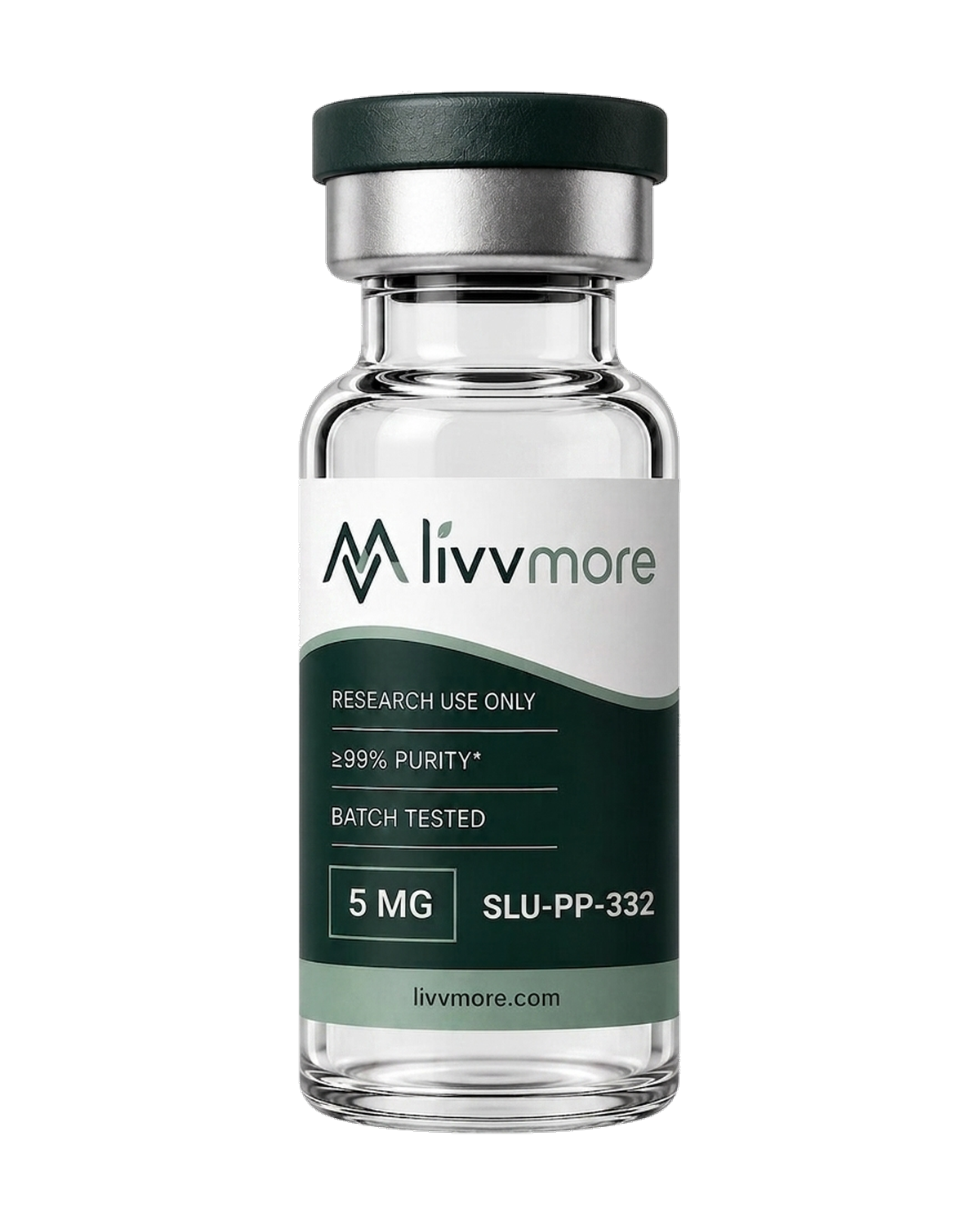
Research peptide
Lyophilized powder, catalogued by compound identity and backed by a certificate of analysis for its production batch.
Indicative · checkout opens at launch
View specifications Batch documentation Certificate of analysis
Documented by batch
Overview
Synthetic pan-ERR agonist for scientific and laboratory research. SLU-PP-332 is a synthetic small-molecule research compound developed as an agonist of the ERR family of nuclear receptors. It is not a peptide. The compound has been characterised as a pan-agonist of ERR subtypes alpha, beta and gamma (ERRalpha, ERRbeta and ERRgamma), with the highest reported potency toward ERRalpha.
Since its initial publication, SLU-PP-332 has become an important preclinical research tool for investigating mitochondrial metabolism, oxidative skeletal-tissue biology, exercise-responsive gene programmes, fatty-acid oxidation and metabolic adaptation.
The ERR receptors are orphan nuclear receptors. Despite the naming of this receptor family, they are functionally distinct from the classical receptor family they are named after and do not share its physiological ligand. ERRalpha, ERRbeta and ERRgamma regulate transcriptional networks involved in mitochondrial biogenesis, oxidative phosphorylation, tricarboxylic-acid metabolism, fatty-acid metabolism and cellular energy demand. Their activity is closely linked to transcriptional coactivators such as PGC-1alpha, which coordinates many of the metabolic adaptations associated with aerobic exercise.
SLU-PP-332 was developed to address the limited availability of synthetic compounds capable of activating ERRalpha in vivo. Earlier pharmacological tools often displayed greater activity at ERRbeta or ERRgamma, or acted as inverse agonists rather than agonists. In the original characterisation, SLU-PP-332 activated all three ERR subtypes and demonstrated sufficient pharmacokinetic properties for use as an in-vivo chemical probe in mice.
The compound is frequently described in popular media as an exercise mimetic. This term requires careful qualification. In published mouse studies, SLU-PP-332 activated portions of an ERRalpha-dependent transcriptional programme associated with acute aerobic exercise, increased oxidative type IIa skeletal fibres and improved aerobic capacity. It did not reproduce every physiological, cardiovascular, neurological, musculoskeletal or behavioural effect of physical exercise, and the findings do not establish that the compound can replace exercise in humans.
Preclinical research has examined the influence of SLU-PP-332 on mitochondrial respiration and cellular energy metabolism. In cultured skeletal myocytes, exposure to the compound increased mitochondrial function and cellular respiration. In mice, the compound increased expression of genes involved in oxidative metabolism and produced changes consistent with a more oxidative skeletal-tissue phenotype. These findings support its use as a research tool for studying nuclear-receptor regulation of mitochondrial and skeletal-tissue biology.
A subsequent study evaluated SLU-PP-332 in mouse models of obesity and metabolic syndrome. In diet-induced obese and genetically obese mice, investigators reported changes in body-composition measures, increased energy expenditure and changes in selected energy-metabolism measures. The reported changes occurred in preclinical models and must not be described as established outcomes in humans.
The metabolic-syndrome research also reported that the compound did not produce its effects by increasing voluntary physical activity or reducing food intake under the tested conditions. Instead, the findings were associated with enhanced oxidative metabolism and energy expenditure. This distinction is scientifically relevant because it suggests that the observed mouse findings were linked to altered metabolic programming rather than behavioural changes.
SLU-PP-332 has also been investigated in preclinical cardiovascular research. Studies in pressure-overload mouse models reported improvements in cardiac function, fibrosis and survival following exposure to SLU-PP-332 or related ERR agonists. These investigations examined transcriptional activation of mitochondrial and fatty-acid-metabolism pathways in cardiac tissue. They do not establish an approved cardiovascular indication or an established effect in humans.
Additional research has explored ERR agonism in age-associated skeletal-tissue and kidney models. Published experimental studies have investigated mitochondrial dysfunction, cellular signalling and metabolic gene expression in ageing-related systems. These findings remain preclinical and require independent replication and human translational research before conclusions about human use can be made.
The current evidence base for SLU-PP-332 is overwhelmingly preclinical. Published studies primarily involve biochemical assays, cultured cells and rodent models. As of the date of this document, no completed peer-reviewed human studies have established the pharmacokinetics, safety, tolerability or activity of SLU-PP-332 in people.
Recent compound-optimisation research has highlighted important development limitations. SLU-PP-332 has very low aqueous kinetic solubility, moderate microsomal stability and poor oral bioavailability. These properties restrict its suitability as a directly translatable drug and have prompted development of newer ERR agonists with improved oral exposure and physicochemical characteristics. A 2026 study described an orally active successor compound, SLU-PP-915, and identified SLU-PP-332 as the earlier reference agonist that improves aerobic capacity in mice but lacks oral bioavailability. This reinforces the description of SLU-PP-332 as a preclinical research tool rather than a developed oral drug.
SLU-PP-332 is presented as a small-molecule ERR-agonist research compound, not a peptide. No human outcome claims are made for it. The ERR family should not be confused with the classical receptor family it is named after; the two have distinct ligand-binding and transcriptional biology.
Analytical quality is especially important for a small-molecule research compound. Product documentation should identify the exact chemical name, molecular formula, molecular mass, CAS number, chromatographic purity, identity-confirmation method and batch number. The Certificate of Analysis should correspond to the material supplied and should not rely solely on a generic supplier specification.
At livvmore, SLU-PP-332 is supplied exclusively for scientific, analytical and laboratory research. Findings from cellular and animal studies should be presented as preclinical observations and should not be extrapolated to human outcomes.
For laboratory research use only. Not for human or veterinary use.
Specifications
Batch documentation
Every batch is third-party tested. The batch-specific certificate of analysis is available on request; the layout below shows the fields it records.
Specimen layout. A batch-specific certificate of analysis is issued for each production run and is available on request.
Testing records
Every batch is accompanied by laboratory records. The entries below describe what each record documents.
High-performance liquid chromatography records the compound’s retention profile against a reference.
Mass spectrometry records the compound’s measured mass to document molecular identity.
The physical appearance of the material is recorded, for example a white lyophilized powder.
Each batch is logged with a lot number and production date for traceability.
These are records of laboratory testing carried out on the batch. They document compound identity for research use and are not a statement of safety, suitability, or fitness for any use.
Research information
SLU-PP-332 is a synthetic pan-agonist of ERRalpha, ERRbeta and ERRgamma and has been used as a chemical probe to investigate transcriptional control of oxidative metabolism. Its published research programme focuses on mitochondrial function, skeletal-tissue adaptation, metabolic syndrome, cardiac bioenergetics and age-related metabolic dysfunction.
The exact molecular and physiological consequences of ERR activation vary by receptor subtype, tissue, exposure level, exposure duration and experimental model. Because SLU-PP-332 is a pan-agonist rather than a highly selective ERRalpha ligand, observed effects may reflect combined activation of multiple ERR subtypes.
SLU-PP-332 has a growing but still limited preclinical evidence base. The key peer-reviewed studies demonstrate receptor agonism, mitochondrial and transcriptional effects in cultured cells, enhanced aerobic capacity and oxidative skeletal-tissue characteristics in mice, and metabolic effects in mouse models of obesity.
Additional animal research has investigated cardiac function, ageing-related skeletal-tissue biology and kidney metabolism. These studies expand the range of experimental applications but do not establish safety or activity in humans.
No peer-reviewed human pharmacokinetic, safety or activity study has established a validated human use for SLU-PP-332. No approved drug is based on SLU-PP-332, and the compound should not be marketed as a drug, supplement or substitute for exercise. The compound’s poor oral bioavailability and low solubility are important translational barriers, and newer ERR agonists are being developed because SLU-PP-332 is best regarded as a reference research tool rather than an optimised drug candidate.
The information summarised here draws on published scientific research and is provided solely for analytical, scientific and educational purposes. livvmore SLU-PP-332 is supplied exclusively for laboratory research. It is a small-molecule research compound and is not a peptide, drug, dietary supplement or approved consumer product.
For laboratory research use only. Not for human or veterinary use.
Frequently asked questions
SLU-PP-332 is catalogued in the Other research compounds collection and supplied as a powder for in-vitro laboratory research. It is listed by CAS number 303760-60-3 and a molecular weight of 290.32 g/mol. It is not for human or veterinary use.
The CAS number recorded for SLU-PP-332 is 303760-60-3.
The molecular weight recorded for SLU-PP-332 is 290.32 g/mol.
SLU-PP-332 is supplied as a powder. Store refrigerated at 2–8°C, protected from light and moisture. For extended storage, follow your laboratory's standard storage procedures.
All products are supplied strictly for in-vitro laboratory research and are not for human or veterinary use, diagnosis, treatment, or personal consumption.
Every batch is third-party tested and documented. The certificate of analysis is available on request.
Every batch is third-party tested, and the batch-specific certificate of analysis is available on request.
By placing an order, purchasers acknowledge that the product is intended solely for laboratory research use and agree to the Research Use Terms.
Fulfilment
Sealed, labelled research vials, packed to protect integrity in transit.
Every batch is third-party tested; the certificate of analysis is available on request.
Supplied to qualified researchers for laboratory research use.
Shipping options and timelines are shown at checkout.
More in this collection
Order
Indicative pricing · checkout opens at launch
Checkout opens at launch, once an approved payment provider is in place.
Every batch is checked against its compound identity before it is catalogued.
A US-based team on hand for catalogue, documentation and order questions.
Batch and lot records are kept for every compound, recorded not asserted.
Each batch is tested by an independent laboratory; the certificate is available on request.
Sealed, labelled research vials, packed to protect integrity in transit.
Orders are prepared and dispatched promptly.