DOCUMENTED BY BATCH
Identity (HPLC)
High-performance liquid chromatography records the compound’s retention profile against a reference.
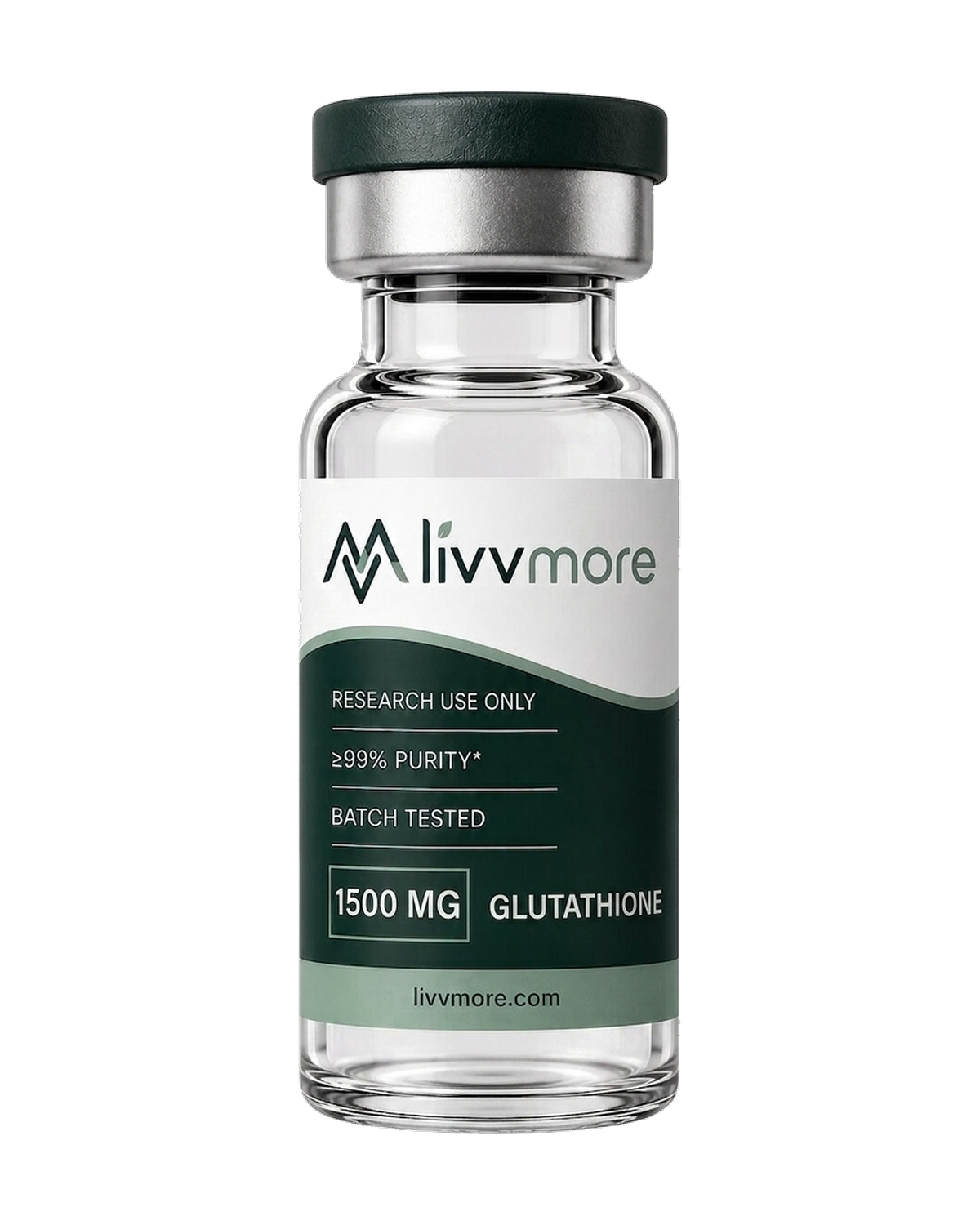
Research peptide
Lyophilized powder, catalogued by compound identity and backed by a certificate of analysis for its production batch.
Indicative · checkout opens at launch
100 in stock
Sealed, labelled vials · US delivery
| Quantity | 5–9 | 10+ |
|---|---|---|
| Discount | 10% | 15% |
| Price | $99.00 | $93.50 |
Indicative volume pricing, confirmed at launch.
View specifications Batch documentation Certificate of analysis
Documented by batch
Overview
Glutathione is a naturally occurring tripeptide composed of glutamate, cysteine, and glycine. It is commonly abbreviated as GSH in its reduced form and is widely studied in biochemistry, cell biology, oxidative chemistry, and redox research.
Glutathione is present across many living systems and participates in thiol chemistry, redox buffering, enzymatic reactions, and cellular signaling. Because of these roles, it is frequently used as a reference compound or research analyte in studies of oxidative balance, cellular metabolism, protein thiol regulation, and glutathione-dependent enzyme systems.
Specifications
Batch documentation
Every batch is third-party tested. The batch-specific certificate of analysis is available on request; the layout below shows the fields it records.
Specimen layout. A batch-specific certificate of analysis is issued for each production run and is available on request.
Testing records
Every batch is accompanied by laboratory records. The entries below describe what each record documents.
High-performance liquid chromatography records the compound’s retention profile against a reference.
Mass spectrometry records the compound’s measured mass to document molecular identity.
The physical appearance of the material is recorded, for example a white lyophilized powder.
Each batch is logged with a lot number and production date for traceability.
These are records of laboratory testing carried out on the batch. They document compound identity for research use and are not a statement of safety, suitability, or fitness for any use.
Research information
Reduced glutathione is commonly represented as GSH. Upon oxidation, glutathione can form glutathione disulfide, commonly abbreviated GSSG. The relationship between GSH and GSSG is widely investigated as part of cellular redox biology.
Glutathione is one of the major low-molecular-weight thiols studied in cellular systems. The GSH/GSSG couple is used extensively in research examining redox homeostasis, oxidative stress, thiol-disulfide exchange, and the response of cells to changing oxidative conditions.
Glutathione participates in several enzyme systems, including glutathione peroxidases, glutathione reductase, glutathione S-transferases, and glutaredoxins. Research on these pathways examines peroxide reduction, conjugation reactions, recycling of oxidized glutathione, protein thiol chemistry, and redox-dependent signaling.
A major research area involving glutathione is reversible protein S-glutathionylation. This process involves formation of mixed disulfides between glutathione and protein thiols and is studied as a mechanism involved in redox regulation, protection of protein cysteine residues, and cell signaling.
Glutathione and GSSG can be investigated using a range of analytical methods, including chromatographic, electrophoretic, spectrometric, photometric, fluorimetric, and electrochemical approaches. Method selection, sample preparation, oxidation control, and storage conditions are especially important because glutathione is redox-active and can change during sample handling.
Because GSH can oxidize to GSSG, researchers should consider temperature, oxygen exposure, light, pH, sample preparation, storage time, and analytical workflow when designing experiments. Appropriate controls and validated methods are important for obtaining reproducible results.
Frequently asked questions
Glutathione is a tripeptide composed of glutamate, cysteine, and glycine. It is widely studied as a low-molecular-weight thiol involved in cellular redox chemistry.
GSH is the common abbreviation for reduced glutathione. Its cysteine thiol group is central to many of the redox reactions investigated in glutathione research.
GSSG is glutathione disulfide, the oxidized form produced when two glutathione molecules form a disulfide bond.
The balance between reduced and oxidized glutathione is widely used in research examining cellular redox state, oxidative conditions, and thiol homeostasis.
Major research systems include glutathione peroxidases, glutathione reductase, glutathione S-transferases, and glutaredoxins.
S-glutathionylation is a reversible post-translational modification in which glutathione forms a mixed disulfide with a protein cysteine residue. It is studied in redox signaling and protein thiol regulation.
Researchers use methods including HPLC, capillary electrophoresis, mass spectrometry, photometric, fluorimetric, and electrochemical detection. The appropriate technique depends on the sample and research objective.
Glutathione is redox-active and can oxidize during collection, preparation, or storage. Poor handling can alter measured GSH and GSSG values and reduce reproducibility.
Relevant factors include temperature, oxygen exposure, pH, light, storage duration, freeze-thaw cycles, matrix composition, and sample preparation procedures.
Researchers may review product identity, stated purity, lot number, storage information, analytical method, certificate of analysis, and any additional batch-specific specifications.
No. HPLC can provide information about chromatographic purity under a defined method, but molecular identity generally requires a separate identity method. Claims should match the actual analytical testing performed.
Not necessarily. Mass spectrometry can support molecular identity by measuring mass-to-charge information, while purity is typically assessed using a validated separation method. The exact conclusion depends on the analytical method and data.
Batch-specific documentation helps researchers connect experimental results to a defined lot and supports repeatability, quality review, and investigation of unexpected results.
No. livvmore Glutathione is presented for laboratory research use only and is not intended for human or veterinary use.
All products are supplied strictly for in-vitro laboratory research and are not for human or veterinary use, diagnosis, treatment, or personal consumption.
Every batch is third-party tested and documented. The certificate of analysis is available on request.
Every batch is third-party tested, and the batch-specific certificate of analysis is available on request.
By placing an order, purchasers acknowledge that the product is intended solely for laboratory research use and agree to the Research Use Terms.
Fulfilment
Sealed, labelled research vials, packed to protect integrity in transit.
Every batch is third-party tested; the certificate of analysis is available on request.
Supplied to qualified researchers for laboratory research use.
Shipping options and timelines are shown at checkout.
More in this collection
Order
Indicative pricing · checkout opens at launch
Checkout opens at launch, once an approved payment provider is in place.
Every batch is checked against its compound identity before it is catalogued.
A US-based team on hand for catalogue, documentation and order questions.
Batch and lot records are kept for every compound, recorded not asserted.
Each batch is tested by an independent laboratory; the certificate is available on request.
Sealed, labelled research vials, packed to protect integrity in transit.
Orders are prepared and dispatched promptly.