DOCUMENTED BY BATCH
Identity (HPLC)
High-performance liquid chromatography records the compound’s retention profile against a reference.
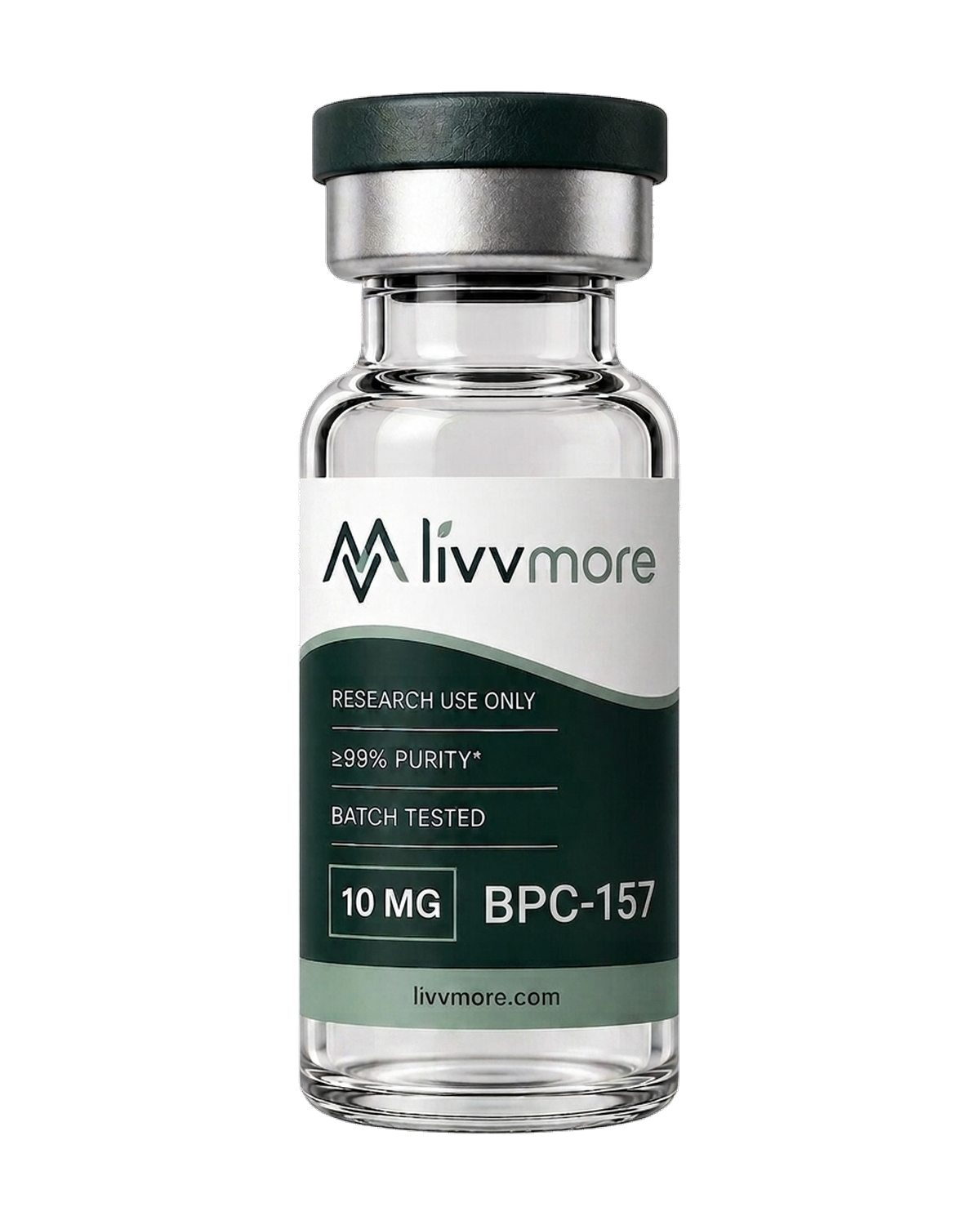
Research peptide
Lyophilized powder, catalogued by compound identity and backed by a certificate of analysis for its production batch.
Indicative · checkout opens at launch
100 in stock
Sealed, labelled vials · US delivery
| Quantity | 5–9 | 10+ |
|---|---|---|
| Discount | 10% | 15% |
| Price | $81.00 | $76.50 |
Indicative volume pricing, confirmed at launch.
View specifications Batch documentation Certificate of analysis
Documented by batch
Overview
livvmore supplies research grade BPC-157 for scientific and laboratory research.
BPC-157 is a synthetic pentadecapeptide consisting of fifteen amino acids and is one of the most extensively investigated experimental peptides in tissue biology research. It has been studied in laboratory settings for more than three decades, with published investigations examining its interactions across gastrointestinal, musculoskeletal, vascular, neurological and connective tissue models. Although the volume of preclinical research has grown substantially, published human evidence remains limited, so BPC-157 is best regarded as an investigational research peptide rather than an agent with established conclusions.
The name BPC refers to Body Protection Compound, a term originally used by researchers investigating protective proteins associated with gastric tissue. BPC-157 is a laboratory-manufactured peptide derived from this line of research and is synthesised using established peptide manufacturing techniques. Modern production methods typically utilise solid-phase peptide synthesis followed by purification using high-performance liquid chromatography (HPLC) and analytical confirmation through techniques such as mass spectrometry.
Since its introduction into the scientific literature during the early 1990s, BPC-157 has generated considerable research interest because of the diversity of biological systems in which it has shown activity under experimental conditions. Published laboratory investigations have examined interactions involving angiogenesis, fibroblast migration, extracellular matrix remodelling, nitric oxide signalling, intracellular signalling pathways, collagen organisation, tendon biology and gastrointestinal mucosal protection. The overwhelming majority of these data originate from laboratory and animal models, and translation to human biology has not yet been established through robust randomised controlled trials.
Unlike many experimental peptides that have relatively narrow research applications, BPC-157 has been investigated across multiple scientific disciplines including gastroenterology, orthopaedics, sports science, vascular biology, neuroscience, pharmacology, molecular biology and tissue biology.
Current laboratory investigations frequently focus on cellular signalling pathways involving vascular endothelial growth factor (VEGF), nitric oxide (NO), fibroblast proliferation, collagen organisation and angiogenesis. These pathways are fundamental components of tissue biology, although the available evidence remains predominantly preclinical.
Within connective tissue research, BPC-157 has been examined in numerous experimental tendon, ligament, skeletal and bone tissue models. Investigators continue studying extracellular matrix organisation, collagen remodelling and cellular migration under controlled laboratory conditions.
One of the defining characteristics of the evidence base is the imbalance between extensive preclinical research and limited human evidence. Existing human investigations remain small and insufficient to establish firm conclusions.
At livvmore, BPC-157 is supplied exclusively for laboratory research. Every batch undergoes quality control procedures to verify peptide identity, purity and consistency before release, with batch-specific Certificates of Analysis (COA) available.
For laboratory research use only. Not for human or veterinary use.
Specifications
Batch documentation
Every batch is third-party tested. The batch-specific certificate of analysis is available on request; the layout below shows the fields it records.
Specimen layout. A batch-specific certificate of analysis is issued for each production run and is available on request.
Testing records
Every batch is accompanied by laboratory records. The entries below describe what each record documents.
High-performance liquid chromatography records the compound’s retention profile against a reference.
Mass spectrometry records the compound’s measured mass to document molecular identity.
The physical appearance of the material is recorded, for example a white lyophilized powder.
Each batch is logged with a lot number and production date for traceability.
These are records of laboratory testing carried out on the batch. They document compound identity for research use and are not a statement of safety, suitability, or fitness for any use.
Research information
BPC-157 is a synthetic pentadecapeptide consisting of 15 amino acids that has been investigated extensively in preclinical models for more than three decades. It has accumulated a substantial body of published laboratory research examining gastrointestinal, musculoskeletal, vascular, neurological and connective tissue systems. Despite this extensive experimental evidence, translation to human systems remains in its early stages and published human evidence is limited.
From a peptide chemistry perspective, BPC-157 is unusual because of its reported stability under acidic conditions compared with many linear peptides. Researchers continue investigating its physicochemical properties, degradation resistance and biological persistence.
Experimental studies have examined angiogenesis, extracellular matrix remodelling, fibroblast migration, nitric oxide signalling, growth factor regulation, collagen organisation and tissue turnover. Most available evidence originates from laboratory and animal studies.
More than three decades of laboratory research have produced a substantial body of animal and in vitro studies investigating BPC-157. However, published human evidence remains extremely limited, with no completed large-scale randomised controlled trials establishing activity for any application.
For laboratory research use only. Not for human or veterinary use.
Frequently asked questions
BPC-157 is catalogued in the Peptide fragments collection and supplied as a white lyophilized powder for in-vitro laboratory research. It is listed by CAS number 137525-51-0 and a molecular weight of 1419.53 g/mol. It is not for human or veterinary use.
The CAS number recorded for BPC-157 is 137525-51-0.
The molecular weight recorded for BPC-157 is 1419.53 g/mol.
BPC-157 is supplied as a white lyophilized powder. Store refrigerated at 2–8°C, protected from light and moisture. For extended storage, follow your laboratory's standard storage procedures.
All products are supplied strictly for in-vitro laboratory research and are not for human or veterinary use, diagnosis, treatment, or personal consumption.
Every batch is third-party tested and documented. The certificate of analysis is available on request.
Every batch is third-party tested, and the batch-specific certificate of analysis is available on request.
By placing an order, purchasers acknowledge that the product is intended solely for laboratory research use and agree to the Research Use Terms.
Fulfilment
Sealed, labelled research vials, packed to protect integrity in transit.
Every batch is third-party tested; the certificate of analysis is available on request.
Supplied to qualified researchers for laboratory research use.
Shipping options and timelines are shown at checkout.
More in this collection
Order
Indicative pricing · checkout opens at launch
Checkout opens at launch, once an approved payment provider is in place.
Every batch is checked against its compound identity before it is catalogued.
A US-based team on hand for catalogue, documentation and order questions.
Batch and lot records are kept for every compound, recorded not asserted.
Each batch is tested by an independent laboratory; the certificate is available on request.
Sealed, labelled research vials, packed to protect integrity in transit.
Orders are prepared and dispatched promptly.