DOCUMENTED BY BATCH
Identity (HPLC)
High-performance liquid chromatography records the compound’s retention profile against a reference.
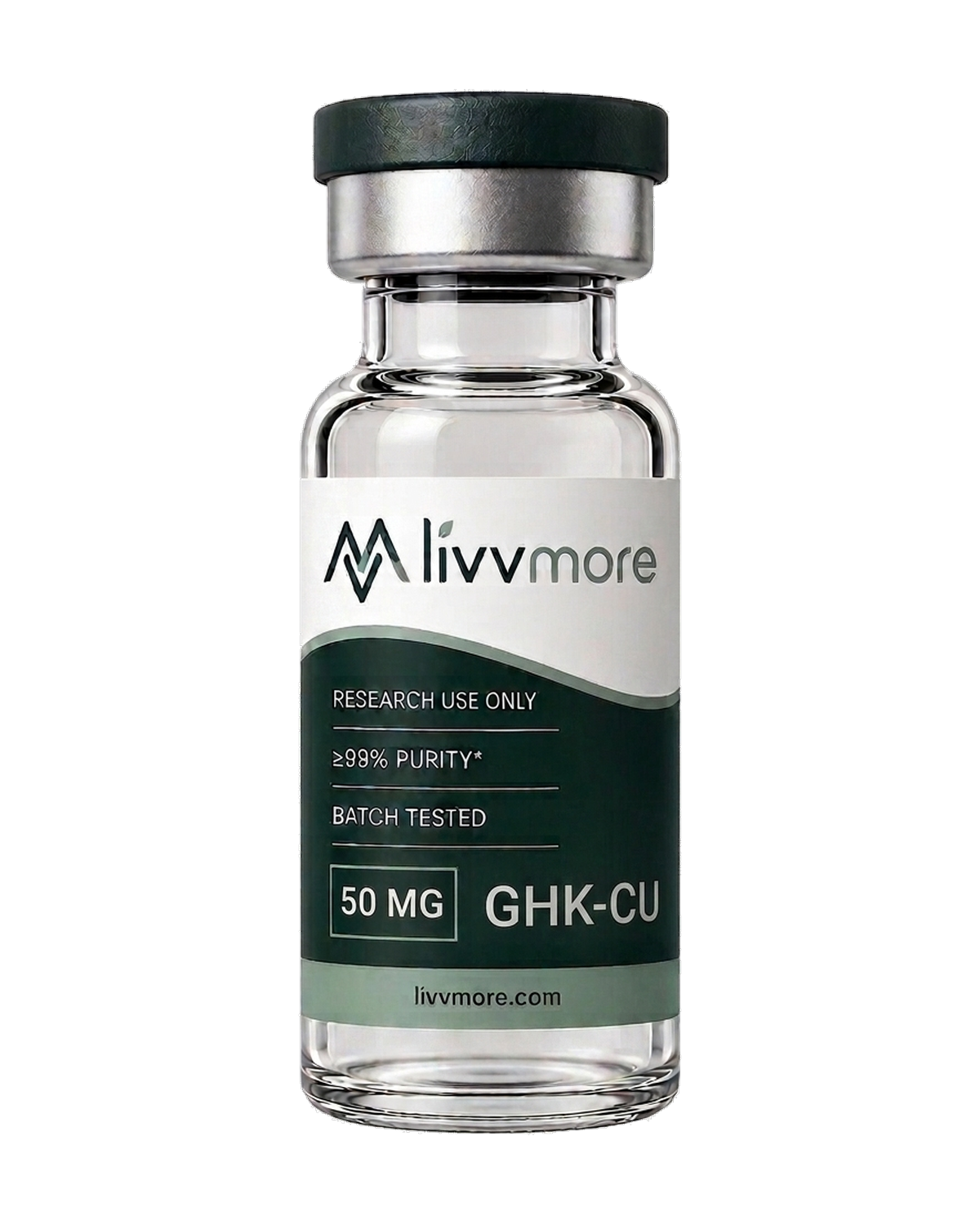
Research peptide
Lyophilized powder, catalogued by compound identity and backed by a certificate of analysis for its production batch.
Indicative · checkout opens at launch
100 in stock
Sealed, labelled vials · US delivery
| Quantity | 5–9 | 10+ |
|---|---|---|
| Discount | 10% | 15% |
| Price | $54.00 | $51.00 |
Indicative volume pricing, confirmed at launch.
View specifications Batch documentation Certificate of analysis
Documented by batch
Overview
Premium research-grade GHK-Cu for scientific and laboratory research.
GHK-Cu, also known as Copper Tripeptide-1 (the copper-binding tripeptide Gly-His-Lys), is a naturally occurring copper-binding tripeptide that has become one of the most extensively investigated compounds in tissue-remodelling biology, extracellular matrix research and connective tissue science. Originally identified in human plasma by Loren Pickart in the early 1970s, GHK-Cu has since been detected in several human tissues and biological fluids, including saliva and urine. Scientific investigations have shown that endogenous concentrations of GHK decline with age, prompting ongoing research into its physiological role and interactions with copper-dependent biological processes.
Unlike many synthetic research peptides developed specifically for pharmaceutical investigation, GHK-Cu is a naturally occurring signalling peptide that forms a stable complex with divalent copper ions (Cu²⁺). Copper is an essential trace element involved in numerous enzymatic reactions, connective tissue formation, antioxidant defence, mitochondrial respiration and cellular metabolism. Because GHK has a high affinity for copper, researchers have investigated its role as a copper transport peptide capable of delivering biologically available copper to cells and tissues under experimental conditions.
Over the past five decades, GHK-Cu has become one of the most widely studied copper peptides within molecular biology and tissue-remodelling research. Published investigations have explored several areas, including:
One of the defining characteristics of GHK-Cu research is its interaction with extracellular matrix biology. Experimental studies have investigated the effects of GHK-Cu on fibroblast behaviour, collagen biology, elastin production, matrix polysaccharide metabolism and matrix metalloproteinase regulation. These processes are fundamental components of normal tissue maintenance and continue to represent major areas of laboratory investigation.
Fibroblasts are among the most extensively studied cell types in GHK-Cu research. Laboratory investigations have examined how GHK-Cu influences fibroblast migration, proliferation and extracellular matrix production under controlled experimental conditions.
Copper homeostasis represents another important area of scientific investigation. Researchers have proposed that GHK-Cu may function as a physiological copper transporter, facilitating the movement of copper ions to tissues requiring this essential trace element.
The relationship between GHK-Cu and collagen biology has generated particular scientific interest. Experimental investigations have examined collagen dynamics, extracellular matrix organisation and connective tissue remodelling following exposure to GHK-Cu in laboratory models.
Angiogenesis, the formation of new blood vessels, represents another active area of GHK-Cu research. Investigators continue studying endothelial cell migration, vascular remodelling, capillary formation and angiogenic signalling pathways in controlled laboratory systems.
Advances in molecular biology have also expanded interest in the influence of GHK-Cu on gene expression. Published experimental studies have reported modulation of numerous genes associated with extracellular matrix biology, cellular signalling, oxidative stress responses, cellular differentiation and tissue maintenance.
The peptide has also become an important research tool in dermatological science and hair follicle biology, with laboratory studies investigating fibroblasts, keratinocytes, dermal papilla cells and extracellular matrix proteins.
At livvmore, GHK-Cu is supplied exclusively for laboratory research and scientific investigation. Every production batch undergoes quality control procedures designed to verify peptide identity, purity and consistency before release. Batch-specific Certificates of Analysis (COA) are available.
Researchers should recognise that although GHK-Cu has one of the strongest evidence bases among research peptides, many proposed molecular mechanisms continue to be investigated and should not be interpreted as established scientific conclusions.
For laboratory research use only. Not for human or veterinary use.
Specifications
Batch documentation
Every batch is third-party tested. The batch-specific certificate of analysis is available on request; the layout below shows the fields it records.
Specimen layout. A batch-specific certificate of analysis is issued for each production run and is available on request.
Testing records
Every batch is accompanied by laboratory records. The entries below describe what each record documents.
High-performance liquid chromatography records the compound’s retention profile against a reference.
Mass spectrometry records the compound’s measured mass to document molecular identity.
The physical appearance of the material is recorded, for example a white lyophilized powder.
Each batch is logged with a lot number and production date for traceability.
These are records of laboratory testing carried out on the batch. They document compound identity for research use and are not a statement of safety, suitability, or fitness for any use.
Research information
GHK-Cu (Copper Tripeptide-1, the tripeptide Gly-His-Lys bound to copper(II)) is among the most extensively studied copper peptides in tissue-remodelling and extracellular-matrix research. Investigators have explored its biochemical properties, interactions with copper ions, extracellular matrix biology, collagen biology, wound biology, cellular signalling and gene regulation. The available evidence spans in vitro studies, animal research and a limited number of human investigations, with stronger evidence in skin biology than for many other proposed research applications.
GHK-Cu has one of the more substantial evidence bases among research peptides. Laboratory and animal studies consistently demonstrate biological activity across tissue-remodelling and extracellular-matrix pathways. Human evidence exists primarily in dermatologic and cosmetic research, but many studies are small and do not establish activity for broader research applications.
The information presented summarises findings from the published scientific literature and is provided solely for scientific and educational purposes. livvmore supplies GHK-Cu exclusively for laboratory research use.
For laboratory research use only. Not for human or veterinary use.
Frequently asked questions
GHK-Cu is catalogued in the Copper peptides collection and supplied as a lyophilized powder for in-vitro laboratory research. It is listed by CAS number 89030-95-5 and a molecular weight of ~401 g/mol (copper(II) complex). It is not for human or veterinary use.
The CAS number recorded for GHK-Cu is 89030-95-5.
The molecular weight recorded for GHK-Cu is ~401 g/mol (copper(II) complex).
GHK-Cu is supplied as a lyophilized powder. Store refrigerated at 2–8°C, protected from light and moisture. For extended storage, follow your laboratory's standard storage procedures.
All products are supplied strictly for in-vitro laboratory research and are not for human or veterinary use, diagnosis, treatment, or personal consumption.
Every batch is third-party tested and documented. The certificate of analysis is available on request.
Every batch is third-party tested, and the batch-specific certificate of analysis is available on request.
By placing an order, purchasers acknowledge that the product is intended solely for laboratory research use and agree to the Research Use Terms.
Fulfilment
Sealed, labelled research vials, packed to protect integrity in transit.
Every batch is third-party tested; the certificate of analysis is available on request.
Supplied to qualified researchers for laboratory research use.
Shipping options and timelines are shown at checkout.
More research compounds
Order
Indicative pricing · checkout opens at launch
Checkout opens at launch, once an approved payment provider is in place.
Every batch is checked against its compound identity before it is catalogued.
A US-based team on hand for catalogue, documentation and order questions.
Batch and lot records are kept for every compound, recorded not asserted.
Each batch is tested by an independent laboratory; the certificate is available on request.
Sealed, labelled research vials, packed to protect integrity in transit.
Orders are prepared and dispatched promptly.