DOCUMENTED BY BATCH
Identity (HPLC)
High-performance liquid chromatography records the compound’s retention profile against a reference.
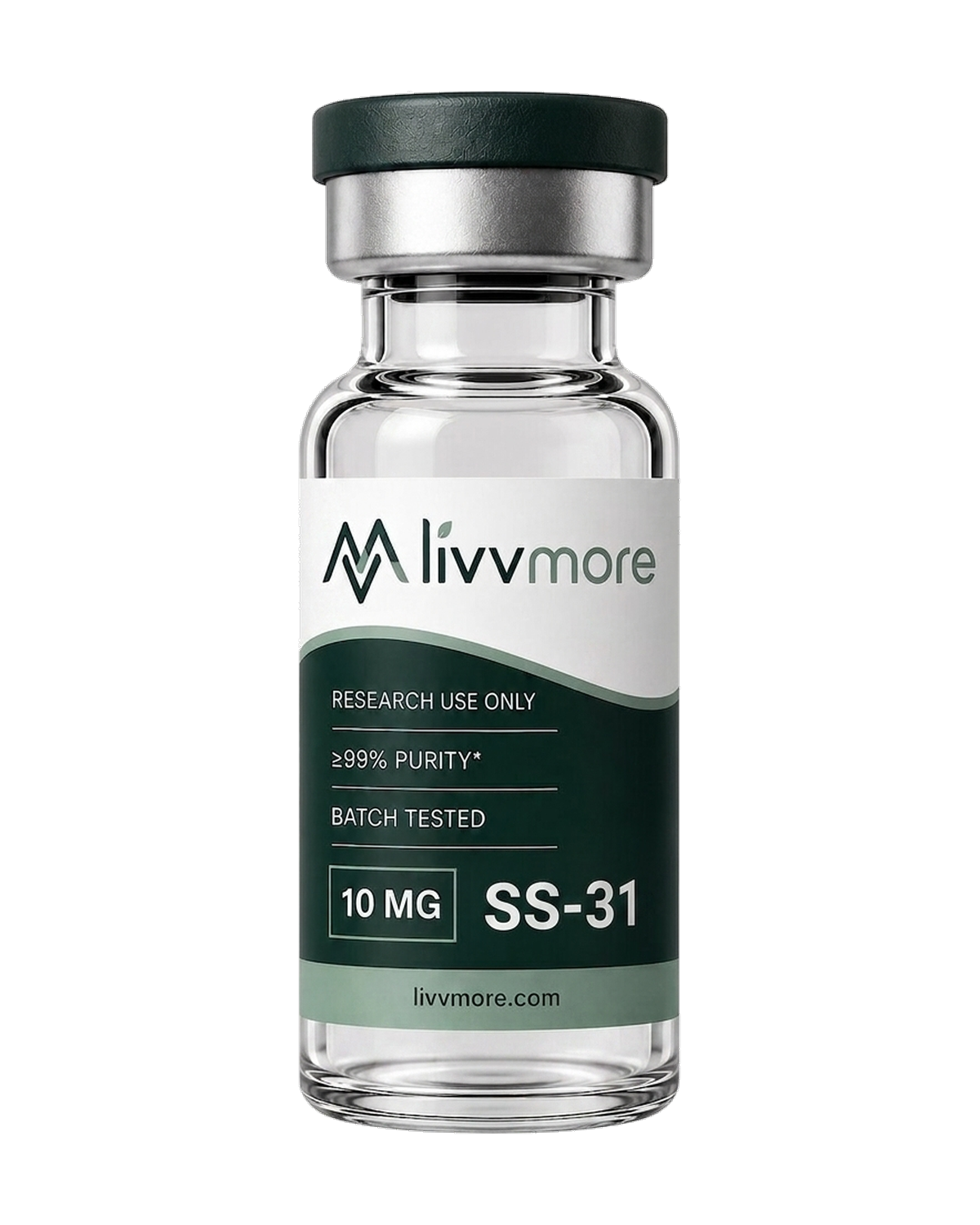
Research peptide
Lyophilized powder, catalogued by compound identity and backed by a certificate of analysis for its production batch.
Indicative · checkout opens at launch
100 in stock
Sealed, labelled vials · US delivery
| Quantity | 5–9 | 10+ |
|---|---|---|
| Discount | 10% | 15% |
| Price | $90.00 | $85.00 |
Indicative volume pricing, confirmed at launch.
View specifications Batch documentation Certificate of analysis
Documented by batch
Overview
SS-31 is a synthetic mitochondria-targeting tetrapeptide studied extensively in mitochondrial biology, bioenergetics, oxidative stress, cellular ageing and tissue physiology. The peptide is also known in the scientific literature as elamipretide, MTP-131 and, historically, Bendavia. SS-31 is composed of four amino-acid residues and belongs to the Szeto-Schiller family of cell-permeable aromatic-cationic peptides.
Unlike peptides that act primarily through a cell-surface receptor, SS-31 is investigated for its ability to localise preferentially to the inner mitochondrial membrane. A major focus of research is its interaction with cardiolipin, a phospholipid highly enriched within that membrane. Cardiolipin contributes to mitochondrial membrane structure, cristae organisation and the function of electron-transport-chain protein complexes. Experimental studies indicate that SS-31 associates with cardiolipin-containing membranes and alters membrane electrostatics and lipid packing without simply disrupting the membrane.
This mitochondrial localisation has made SS-31 an important research tool for investigating how membrane organisation influences oxidative phosphorylation, electron transport, adenosine triphosphate production and reactive oxygen species formation. Earlier descriptions frequently characterised SS-31 primarily as a mitochondria-targeted antioxidant. Current research presents a broader and more nuanced model involving cardiolipin binding, membrane stabilisation, mitochondrial protein interactions and improved organisation of bioenergetic machinery.
The mitochondrial inner membrane contains the electron transport system responsible for converting energy from nutrients into an electrochemical proton gradient that supports ATP synthesis. Structural disruption, abnormal cardiolipin composition, excess electron leakage and altered cristae architecture can impair this process. SS-31 is therefore widely investigated in experimental models of mitochondrial dysfunction, where researchers examine respiration, membrane potential, proton leak, ATP-generating capacity, redox balance and mitochondrial ultrastructure.
Laboratory evidence indicates that SS-31 interacts with a broader network of mitochondrial proteins in addition to cardiolipin. Proteomic research has identified associations with proteins involved in energy metabolism, mitochondrial structure and membrane transport, although the relative importance of these interactions remains under investigation. Experimental work has also reported direct interaction with the adenine nucleotide translocator, a mitochondrial inner-membrane protein involved in exchanging ATP and ADP across the membrane.
Research involving SS-31 spans molecular biology, mitochondrial science, cardiology, nephrology, neurology, ophthalmology, skeletal-tissue physiology and ageing biology. Preclinical investigations have examined mitochondrial dysfunction in cardiac tissue, skeletal tissue, kidney models, neural tissue and the retina. These studies frequently assess oxidative stress, respiratory capacity, cellular energetics, cellular stress signalling and tissue-specific mitochondrial adaptation.
In ageing research, SS-31 has been used to investigate whether restoring mitochondrial function can influence age-associated physiological decline. Mouse studies have reported improvements in mitochondrial redox balance, cardiac function and exercise tolerance following experimental SS-31 exposure. These results are preclinical and should not be assumed to establish equivalent outcomes in humans.
Kidney research has examined SS-31 in models of acute and chronic renal injury, mitochondrial depolarisation, oxidative stress and cellular damage. Published reviews describe potentially protective effects across several experimental renal models while also noting that underlying mechanisms and translation to humans remain incompletely established.
SS-31 has progressed substantially further through formal drug development than many compounds sold within the research-peptide category. Under the generic name elamipretide, the compound has been evaluated in human trials involving primary mitochondrial myopathy, Barth syndrome, heart failure and ophthalmic conditions. Findings have varied by study and indication. For example, an earlier dose-escalation study in primary mitochondrial myopathy reported improvement in a walking assessment, whereas a later 24-week, placebo-controlled Phase 3 study did not demonstrate significant improvement in its primary walking or fatigue endpoints.
A regulatory update should be reflected accurately on this page. In September 2025, the U.S. FDA granted accelerated approval to the prescription product Forzinity (elamipretide) for a defined indication in Barth syndrome, in patients weighing at least 30 kilograms. The approval was based on an intermediate study endpoint, and continued approval may depend on confirmation in additional trials.
This approval applies specifically to the approved prescription formulation, indication and patient population. It does not mean that all SS-31 products are approved by the FDA, nor does it establish activity for ageing, kidney disease, heart failure, primary mitochondrial myopathy, neurological conditions or other proposed applications. Research in those areas should continue to be described as investigational unless supported by a separate regulatory approval.
Because an approved elamipretide drug now exists, livvmore clearly distinguishes its laboratory product from Forzinity. The website does not suggest that the livvmore product is the approved prescription drug, a substitute for it or intended for the approved Barth syndrome indication. livvmore SS-31 is presented exclusively as laboratory research material, supported by product-specific analytical documentation.
At livvmore, SS-31 is supplied for scientific and laboratory investigation. Product identity and purity claims are based on the actual batch-specific Certificate of Analysis rather than general statements. Where applicable, documentation may include chromatographic purity testing and analytical confirmation of molecular identity.
Researchers should also recognise that results vary considerably according to experimental model, tissue type, mitochondrial condition, formulation, concentration, exposure conditions and study duration. Findings from isolated cells or animal models cannot automatically be extrapolated to humans. Even where human trials exist, results from one disorder do not establish activity in another.
For laboratory research use only. Not for human or veterinary use.
Specifications
Batch documentation
Every batch is third-party tested. The batch-specific certificate of analysis is available on request; the layout below shows the fields it records.
Specimen layout. A batch-specific certificate of analysis is issued for each production run and is available on request.
Testing records
Every batch is accompanied by laboratory records. The entries below describe what each record documents.
High-performance liquid chromatography records the compound’s retention profile against a reference.
Mass spectrometry records the compound’s measured mass to document molecular identity.
The physical appearance of the material is recorded, for example a white lyophilized powder.
Each batch is logged with a lot number and production date for traceability.
These are records of laboratory testing carried out on the batch. They document compound identity for research use and are not a statement of safety, suitability, or fitness for any use.
Research information
SS-31 is an aromatic-cationic tetrapeptide developed to target mitochondria without requiring a highly negative mitochondrial membrane potential for uptake. It is studied primarily for its localisation to the inner mitochondrial membrane and its interaction with cardiolipin. This distinguishes SS-31 from conventional antioxidants that may act more diffusely within cells.
The contemporary scientific model of SS-31 activity extends beyond direct free-radical scavenging. Research now focuses on cardiolipin-dependent membrane organisation, electron-transport efficiency, respiratory supercomplex function, cristae integrity, protein-lipid interactions and regulation of mitochondrial redox balance. However, its complete mechanism has not been resolved, and different experimental findings may reflect multiple interacting effects rather than a single molecular target. This section summarises findings from scientific publications and regulatory sources for educational and laboratory-research purposes.
Active SS-31 research spans several overlapping fields, each examining a different aspect of mitochondrial structure, energetics and physiology:
SS-31 has a more advanced evidence base than many experimental peptides because it has undergone preclinical investigation, multiple controlled human trials and regulatory review. Nevertheless, evidence differs substantially by indication.
For primary mitochondrial myopathy, early findings were encouraging, but the larger MMPOWER-3 study did not separate from placebo for the principal walking and fatigue measures at 24 weeks. Post-hoc analyses have explored whether genetically defined subgroups may respond differently, but such analyses are exploratory and require prospective confirmation.
For Barth syndrome, the FDA has granted accelerated approval for a specific prescription formulation and population. For other proposed applications, including ageing, renal disorders, heart failure, neurological disease and most metabolic uses, SS-31 remains investigational. The evidence should therefore be described according to indication rather than characterised broadly as either proven or unproven.
For laboratory research use only. Not for human or veterinary use.
Frequently asked questions
SS-31 (Elamipretide) is catalogued in the Mitochondrial research peptides collection and supplied as a white lyophilized powder for in-vitro laboratory research. It is listed by CAS number 736992-21-5 and a molecular weight of 639.8 g/mol. It is not for human or veterinary use.
The CAS number recorded for SS-31 (Elamipretide) is 736992-21-5.
The molecular weight recorded for SS-31 (Elamipretide) is 639.8 g/mol.
SS-31 (Elamipretide) is supplied as a white lyophilized powder. Store refrigerated at 2–8°C, protected from light and moisture. For extended storage, follow your laboratory's standard storage procedures.
All products are supplied strictly for in-vitro laboratory research and are not for human or veterinary use, diagnosis, treatment, or personal consumption.
Every batch is third-party tested and documented. The certificate of analysis is available on request.
Every batch is third-party tested, and the batch-specific certificate of analysis is available on request.
By placing an order, purchasers acknowledge that the product is intended solely for laboratory research use and agree to the Research Use Terms.
Fulfilment
Sealed, labelled research vials, packed to protect integrity in transit.
Every batch is third-party tested; the certificate of analysis is available on request.
Supplied to qualified researchers for laboratory research use.
Shipping options and timelines are shown at checkout.
Order
Indicative pricing · checkout opens at launch
Checkout opens at launch, once an approved payment provider is in place.
Every batch is checked against its compound identity before it is catalogued.
A US-based team on hand for catalogue, documentation and order questions.
Batch and lot records are kept for every compound, recorded not asserted.
Each batch is tested by an independent laboratory; the certificate is available on request.
Sealed, labelled research vials, packed to protect integrity in transit.
Orders are prepared and dispatched promptly.