DOCUMENTED BY BATCH
Identity (HPLC)
High-performance liquid chromatography records the compound’s retention profile against a reference.
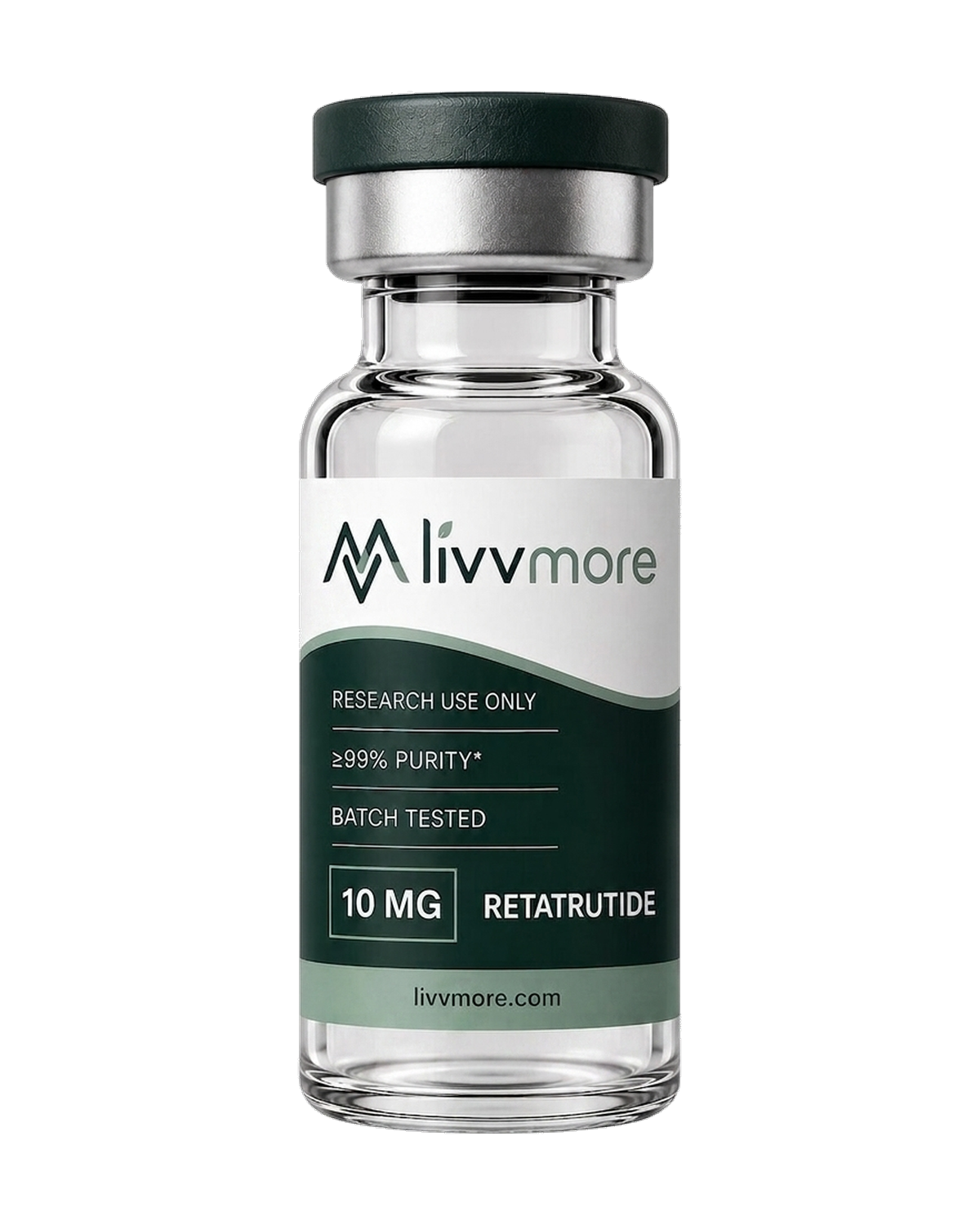
Research peptide
Lyophilized powder, catalogued by compound identity and backed by a certificate of analysis for its production batch.
Indicative · checkout opens at launch
100 in stock
Sealed, labelled vials · US delivery
| Quantity | 5–9 | 10+ |
|---|---|---|
| Discount | 10% | 15% |
| Price | $135.00 | $127.50 |
Indicative volume pricing, confirmed at launch.
View specifications Batch documentation Certificate of analysis
Documented by batch
Overview
Retatrutide is a synthetic single-chain peptide catalogued by livvmore for laboratory research applications. It is identified by CAS number 2381089-83-2 and carries a molecular weight of 4731.33 g/mol. Each unit is supplied as a lyophilized powder in 10 mg and 30 mg vial formats, accompanied by batch documentation and a certificate of analysis on request.
Within the scientific literature, retatrutide is classified as a synthetic triagonist peptide: a single molecule engineered to engage three distinct receptor targets. It sits within the broader family of GLP research peptides that laboratories catalogue and characterise by receptor affinity, molecular structure and analytical profile. This page describes the compound’s identity and the research topics it appears under. No health, medical, therapeutic or performance claims are made or implied.
Retatrutide is an acylated peptide built on a modified peptide backbone carrying a lipid side chain, a design that supports extended circulation in laboratory models. It is studied as a unimolecular triagonist, meaning one peptide sequence engages the GLP-1 receptor, the GIP receptor and the glucagon receptor together rather than through separate molecules.
Investigators typically confirm the identity and structural characterisation of each batch using analytical methods such as HPLC and mass spectrometry, with results recorded in the accompanying certificate of analysis.
Retatrutide draws research interest because its triple-receptor design offers a single-molecule model for examining how incretin and glucagon receptor pathways engage together under controlled, in-vitro and cellular conditions. Comparative peptide pharmacology, receptor-binding characterisation and structure-activity investigation are recurring themes across the published record.
All such work is confined to the laboratory. livvmore supplies retatrutide strictly as a research material for qualified investigators and offers no guidance for any non-laboratory application.
For laboratory research use only. Not for human or veterinary use.
Specifications
Batch documentation
Every batch is third-party tested. The batch-specific certificate of analysis is available on request; the layout below shows the fields it records.
Specimen layout. A batch-specific certificate of analysis is issued for each production run and is available on request.
Testing records
Every batch is accompanied by laboratory records. The entries below describe what each record documents.
High-performance liquid chromatography records the compound’s retention profile against a reference.
Mass spectrometry records the compound’s measured mass to document molecular identity.
The physical appearance of the material is recorded, for example a white lyophilized powder.
Each batch is logged with a lot number and production date for traceability.
These are records of laboratory testing carried out on the batch. They document compound identity for research use and are not a statement of safety, suitability, or fitness for any use.
Research information
Retatrutide has become a frequent reference point in peptide receptor pharmacology, where investigators study synthetic triagonists that address more than one receptor with a single sequence. Published laboratory and molecular work characterises its receptor-binding profile, structural features and its relationship to earlier incretin-class peptides. livvmore catalogues the compound by molecular identity so that researchers can source a consistent, batch-documented material for their own in-vitro and laboratory investigation.
Research themes commonly associated with retatrutide across the scientific record include:
For laboratory research use only. Not for human or veterinary use.
Frequently asked questions
Retatrutide is catalogued in the GLP research peptides collection and supplied as a white lyophilized powder for in-vitro laboratory research. It is listed by CAS number 2381089-83-2 and a molecular weight of 4731.33 g/mol. It is not for human or veterinary use.
The CAS number recorded for Retatrutide is 2381089-83-2.
The molecular weight recorded for Retatrutide is 4731.33 g/mol.
Retatrutide is supplied as a white lyophilized powder. Store refrigerated at 2–8°C, protected from light and moisture. For extended storage, follow your laboratory's standard storage procedures.
All products are supplied strictly for in-vitro laboratory research and are not for human or veterinary use, diagnosis, treatment, or personal consumption.
Every batch is third-party tested and documented. The certificate of analysis is available on request.
Every batch is third-party tested, and the batch-specific certificate of analysis is available on request.
By placing an order, purchasers acknowledge that the product is intended solely for laboratory research use and agree to the Research Use Terms.
Fulfilment
Sealed, labelled research vials, packed to protect integrity in transit.
Every batch is third-party tested; the certificate of analysis is available on request.
Supplied to qualified researchers for laboratory research use.
Shipping options and timelines are shown at checkout.
Order
Indicative pricing · checkout opens at launch
Checkout opens at launch, once an approved payment provider is in place.
Every batch is checked against its compound identity before it is catalogued.
A US-based team on hand for catalogue, documentation and order questions.
Batch and lot records are kept for every compound, recorded not asserted.
Each batch is tested by an independent laboratory; the certificate is available on request.
Sealed, labelled research vials, packed to protect integrity in transit.
Orders are prepared and dispatched promptly.