DOCUMENTED BY BATCH
Identity (HPLC)
High-performance liquid chromatography records the compound’s retention profile against a reference.
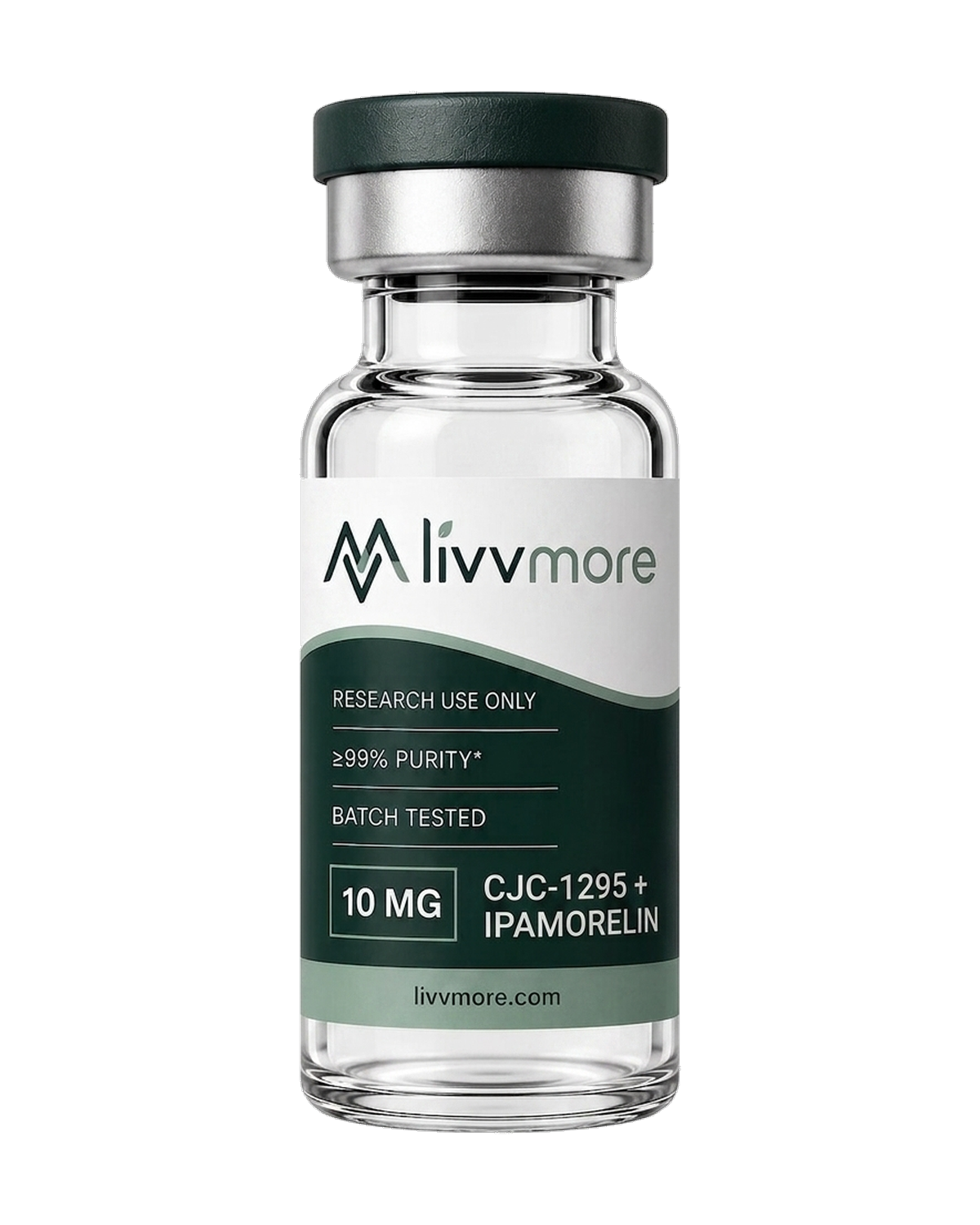
Research peptide
Lyophilized powder, catalogued by compound identity and backed by a certificate of analysis for its production batch.
Indicative · checkout opens at launch
100 in stock
Sealed, labelled vials · US delivery
| Quantity | 5–9 | 10+ |
|---|---|---|
| Discount | 10% | 15% |
| Price | $90.00 | $85.00 |
Indicative volume pricing, confirmed at launch.
View specifications Batch documentation Certificate of analysis
Documented by batch
Overview
Dual-pathway GH signalling research for scientific and laboratory investigation.
CJC-1295 and Ipamorelin are two synthetic research compounds studied for their effects on the GH axis through distinct but complementary signalling pathways. CJC-1295 is a modified analogue of GHRH, while Ipamorelin is a synthetic pentapeptide that acts as an agonist at the GH secretagogue receptor, also known as the ghrelin receptor or GHSR-1a.
Because the two compounds act through different receptor systems, their combination has become a subject of laboratory interest in research examining GH secretion, pituitary signalling, hypothalamic regulation, receptor pharmacology and the relationship between GH and IGF-1.
The combination should not be described as a single peptide. It is a blend of two separate research compounds with different structures, receptor targets and pharmacological characteristics. CJC-1295 primarily investigates the GHRH receptor pathway, while Ipamorelin is studied through the GH secretagogue receptor pathway.
CJC-1295 was developed as a long-acting analogue of a human GH-releasing factor. Native GHRH has a short biological duration because it is rapidly degraded. CJC-1295 with drug affinity complex (DAC) was engineered to resist enzymatic breakdown and to bind covalently to circulating albumin through a maleimide-containing moiety, substantially prolonging exposure compared with native GHRH.
Early human studies evaluated CJC-1295 in healthy adults through randomised, placebo-controlled, double-blind, ascending-dose trials. These investigations reported sustained, dose-dependent increases in circulating GH and IGF-1. Multiple doses produced evidence of a cumulative pharmacodynamic effect, while IGF-1 remained elevated during the study period. These findings established CJC-1295 as a useful investigational compound for studying prolonged activation of the GHRH receptor pathway.
Research also showed that CJC-1295 increased trough and mean GH secretion while preserving pulsatile release. This distinction is scientifically important because endogenous GH is normally secreted in pulses rather than at a constant rate.
Ipamorelin is structurally and mechanistically different. It is a synthetic pentapeptide and ghrelin mimetic that binds to the GH secretagogue receptor. The National Cancer Institute describes Ipamorelin as a pentapeptide ghrelin mimetic with GH-releasing activity that binds to the ghrelin receptor and stimulates pituitary GH release. It should not be described as binding directly to the IGF-1 receptor.
Ipamorelin was initially characterised as a comparatively selective GH secretagogue. In early preclinical research, it stimulated GH release with less activation of ACTH and cortisol pathways than several earlier GH-releasing peptides under the conditions tested. This does not establish that Ipamorelin is free from off-target effects or that it behaves comparably in other settings.
The scientific rationale for combining CJC-1295 and Ipamorelin arises from their activation of separate components of the GH regulatory system. GHRH receptor agonism and GH secretagogue receptor agonism can produce additive responses in experimental models because the receptors initiate distinct intracellular signalling processes within pituitary somatotroph cells.
GHRH receptor activation is primarily associated with G-protein-mediated increases in cyclic adenosine monophosphate and protein kinase A signalling. The ghrelin receptor primarily couples to Gq/11-related pathways involving phospholipase C, inositol trisphosphate and intracellular calcium mobilisation. Studying the two pathways together can provide insight into how pituitary GH secretion is regulated through overlapping but distinct intracellular pathways.
There is an important evidence limitation. Although CJC-1295 and Ipamorelin have each been investigated independently, high-quality peer-reviewed human research evaluating the specific combined CJC-1295 and Ipamorelin formulation sold by research suppliers is limited. Statements about the blend must therefore be based on the individual pharmacology of each compound rather than presented as established outcomes of the exact combination.
The designation CJC-1295 requires careful clarification. In research and commercial markets, the name is sometimes used inconsistently for compounds with and without the drug affinity complex. Authentic CJC-1295 with DAC contains a maleimide-containing extension designed to bind albumin and extend circulation time. Products marketed as “CJC-1295 without DAC” are generally shorter-acting modified GRF analogues and are not pharmacologically identical to CJC-1295 with DAC.
The livvmore product page states whether its CJC-1295 component contains DAC. This distinction affects molecular identity, expected duration of exposure, laboratory design and interpretation of experimental results. The product name, specifications, Certificate of Analysis and product description use consistent terminology.
CJC-1295 has human pharmacokinetic and pharmacodynamic data from early controlled studies. Single doses produced dose-dependent increases in GH and IGF-1, with effects persisting for several days. Repeated exposure maintained elevated IGF-1 concentrations during the study period. These studies provide evidence of target-pathway activation but do not establish outcomes for body composition or other commonly promoted uses.
A Phase 2 study was registered to investigate CJC-1295 in people with HIV-associated visceral obesity. The study record is listed as terminated and no results are posted in the registry. A trial registration does not establish activity, safety or regulatory approval.
Ipamorelin has a different research history. It was evaluated in a randomised Phase 2 proof-of-concept study for postoperative ileus following bowel resection. The study investigated gastrointestinal motility through ghrelin-receptor signalling rather than body composition or other promoted uses. Published findings did not establish a statistically significant effect for the primary endpoint.
Preclinical studies have also examined Ipamorelin in rodent models of delayed gastric emptying and postoperative ileus. These studies reported effects on gastrointestinal transit under specific experimental conditions. Findings from animal models should not be generalised beyond the study design or interpreted as proof of effect in humans.
Research into the GH and IGF-1 axis is complex because these signalling systems influence many tissues and biological processes. GH acts directly through the GH receptor and indirectly through regulation of IGF-1 production. Changes in circulating GH concentrations do not automatically establish a beneficial physiological or applied outcome.
Excessive or prolonged stimulation of GH and IGF-1 pathways may influence energy metabolism pathways, fluid balance, tissue growth and other endocrine processes. The page therefore avoids presenting increased GH or IGF-1 as inherently beneficial.
CJC-1295 and Ipamorelin are relevant to anti-doping regulation. The 2026 World Anti-Doping Agency Prohibited List includes CJC-1295 among GHRH analogues and Ipamorelin among GH secretagogues. Athletes should not interpret a research-use-only label as meaning that these compounds are permitted in sport.
At livvmore, CJC-1295 + Ipamorelin is supplied exclusively for laboratory research and analytical investigation. Every batch is supported by product-specific documentation confirming the identity and quantity of both components. Because this is a blended product, the Certificate of Analysis distinguishes total content from the amount of each individual peptide.
Analytical documentation may include high-performance liquid chromatography for purity assessment and mass spectrometry for molecular identity. A single combined purity percentage does not necessarily confirm the correct ratio of two compounds, so blend-ratio verification is particularly important.
Researchers should confirm whether the product contains CJC-1295 with DAC or a shorter-acting modified GRF analogue before designing experiments. They should also account for the compounds’ different receptor targets, pharmacokinetic properties and analytical characteristics.
For laboratory research use only. Not for human or veterinary use.
Specifications
Batch documentation
Every batch is third-party tested. The batch-specific certificate of analysis is available on request; the layout below shows the fields it records.
Specimen layout. A batch-specific certificate of analysis is issued for each production run and is available on request.
Testing records
Every batch is accompanied by laboratory records. The entries below describe what each record documents.
High-performance liquid chromatography records the compound’s retention profile against a reference.
Mass spectrometry records the compound’s measured mass to document molecular identity.
The physical appearance of the material is recorded, for example a white lyophilized powder.
Each batch is logged with a lot number and production date for traceability.
These are records of laboratory testing carried out on the batch. They document compound identity for research use and are not a statement of safety, suitability, or fitness for any use.
Research information
CJC-1295 and Ipamorelin are studied within the GH regulatory axis but act through separate receptor pathways. CJC-1295 is a GHRH analogue that activates the GHRH receptor, while Ipamorelin is a ghrelin mimetic that activates the GH secretagogue receptor.
The combined formulation is used experimentally to investigate dual-pathway pituitary signalling. The evidence supporting the exact blend is less extensive than the evidence for the individual compounds. Descriptions of the blend should clearly separate established findings concerning CJC-1295 or Ipamorelin from hypotheses about their combined activity.
Research on these compounds spans receptor pharmacology, signalling biology, pharmacokinetics and analytical characterisation. Active areas include the following.
CJC-1295 has human pharmacokinetic and pharmacodynamic data from early randomised controlled studies. These studies demonstrated prolonged increases in GH and IGF-1 and provide evidence that the compound activates the intended endocrine pathway. They did not establish broad applied outcomes or support commercial claims relating to body composition or other promoted uses.
Ipamorelin has preclinical receptor-selectivity research, animal gastrointestinal studies and limited human research, including a Phase 2 trial for postoperative ileus. The published Phase 2 findings did not establish a statistically significant effect for the primary endpoint.
Evidence for the exact combined CJC-1295 + Ipamorelin formulation is substantially more limited. Commercial popularity is not equivalent to scientific validation.
Neither CJC-1295 nor Ipamorelin is an approved drug. A different GHRH analogue, tesamorelin, holds regulatory approval for a specific indication, but that approval does not extend to CJC-1295, Ipamorelin or this blend. The livvmore product is presented solely as research material.
This section summarises findings from published scientific research and authoritative reference sources. It is provided solely for scientific, analytical and educational purposes. livvmore CJC-1295 + Ipamorelin is supplied exclusively for laboratory research and is not an approved drug. The product page and Certificate of Analysis state whether the CJC-1295 component contains DAC and identify the amount of each compound in the blend.
For laboratory research use only. Not for human or veterinary use.
Frequently asked questions
CJC-1295 (No-DAC) + Ipamorelin is catalogued in the Co-formulated research peptides collection and supplied as a white lyophilized powder for in-vitro laboratory research. It is not for human or veterinary use.
CJC-1295 (No-DAC) + Ipamorelin is supplied as a white lyophilized powder. Store refrigerated at 2–8°C, protected from light and moisture. For extended storage, follow your laboratory's standard storage procedures.
All products are supplied strictly for in-vitro laboratory research and are not for human or veterinary use, diagnosis, treatment, or personal consumption.
Every batch is third-party tested and documented. The certificate of analysis is available on request.
Every batch is third-party tested, and the batch-specific certificate of analysis is available on request.
By placing an order, purchasers acknowledge that the product is intended solely for laboratory research use and agree to the Research Use Terms.
Fulfilment
Sealed, labelled research vials, packed to protect integrity in transit.
Every batch is third-party tested; the certificate of analysis is available on request.
Supplied to qualified researchers for laboratory research use.
Shipping options and timelines are shown at checkout.
More in this collection
Order
Indicative pricing · checkout opens at launch
Checkout opens at launch, once an approved payment provider is in place.
Every batch is checked against its compound identity before it is catalogued.
A US-based team on hand for catalogue, documentation and order questions.
Batch and lot records are kept for every compound, recorded not asserted.
Each batch is tested by an independent laboratory; the certificate is available on request.
Sealed, labelled research vials, packed to protect integrity in transit.
Orders are prepared and dispatched promptly.