DOCUMENTED BY BATCH
Identity (HPLC)
High-performance liquid chromatography records the compound’s retention profile against a reference.
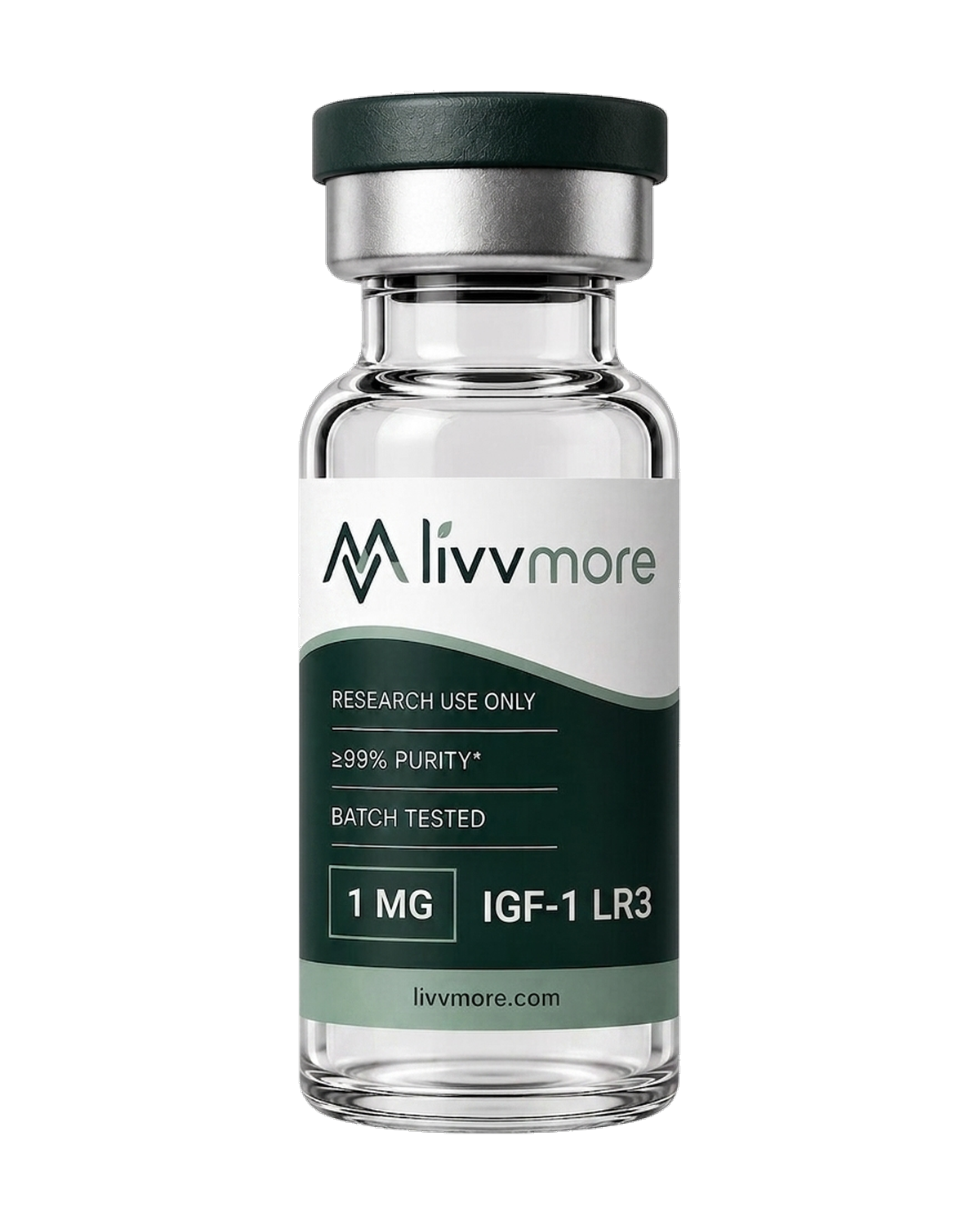
Research peptide
Lyophilized powder, catalogued by compound identity and backed by a certificate of analysis for its production batch.
Indicative · checkout opens at launch
100 in stock
Sealed, labelled vials · US delivery
| Quantity | 5–9 | 10+ |
|---|---|---|
| Discount | 10% | 15% |
| Price | $99.00 | $93.50 |
Indicative volume pricing, confirmed at launch.
View specifications Batch documentation Certificate of analysis
Documented by batch
Overview
Long R3 IGF-1 for scientific and laboratory research. IGF-1 LR3, also written as Long R3 IGF-1 or LR3-IGF-1, is a recombinant analogue of human IGF-1 developed for laboratory research. It is not identical to endogenous human IGF-1 and should not be described as mecasermin, the recombinant human IGF-1 prescription product approved by the U.S. FDA. IGF-1 LR3 is an investigational research peptide whose published evidence is predominantly preclinical.
Native mature human IGF-1 is a single-chain peptide containing 70 amino acids and three intramolecular disulfide bonds. IGF-1 LR3 contains 83 amino acids. It incorporates an arginine substitution at position 3 and a 13-amino-acid extension at the amino terminus. These modifications were designed to reduce interaction with IGF-binding proteins and to increase biological activity in experimental systems compared with native IGF-1.
The term LR3 therefore describes a specific molecular analogue rather than a general form of IGF-1. Product identity should be confirmed using batch-specific analytical documentation. The product name, sequence, molecular mass, purity data and Certificate of Analysis should all refer consistently to IGF-1 LR3 rather than native IGF-1, mecasermin or another IGF analogue.
IGF-1 is an endogenous signalling peptide and growth factor produced in many tissues. Circulating IGF-1 is strongly influenced by systemic growth signalling, particularly through hepatic production, while local IGF-1 synthesis also contributes to paracrine and autocrine signalling. The IGF system includes IGF-1, IGF-2, the type 1 IGF receptor, related receptors, multiple IGF-binding proteins and binding-protein proteases. These interacting components regulate the availability, distribution and duration of IGF signalling.
Most endogenous IGF-1 in the circulation is bound to IGF-binding proteins rather than remaining freely available. IGF-binding proteins regulate transport, tissue distribution, receptor access and biological half-life. The reduced binding of IGF-1 LR3 to several IGF-binding proteins is one of the principal reasons it is used as an experimental analogue. This property can produce greater apparent potency in some cell and animal models, but the magnitude of the effect depends on the biological system, assay conditions, receptor expression and binding-protein environment.
IGF-1 primarily signals through the type 1 IGF receptor (IGF1R), a receptor tyrosine kinase within the same receptor family. Ligand binding promotes receptor autophosphorylation and recruitment of intracellular adaptor proteins. Major downstream pathways include phosphoinositide 3-kinase-AKT signalling and RAS-RAF-MEK-ERK signalling. These pathways participate in cell survival, metabolism, proliferation, differentiation and protein synthesis. Their effects are highly dependent on cell type, developmental stage and experimental context.
IGF-1 can also interact with related receptors and hybrid receptors formed with IGF1R subunits. Receptor selectivity is therefore not absolute. Experimental interpretation should consider receptor abundance, receptor isoforms and potential cross-talk between IGF and related receptor signalling. Describing IGF-1 LR3 as acting through a single isolated pathway would oversimplify the biology.
Because IGF signalling can support proliferation and survival in responsive cells, IGF-1 LR3 has been used in cell-culture research involving myoblasts, fibroblasts, chondrocytes, neurons, stem-cell systems and other experimental models. It is also used in studies of receptor activation, protein synthesis, differentiation, nutrient signalling and tissue development. These are laboratory applications and do not establish activity or safety in humans.
Cellular and tissue-level biology is one prominent research area. Endogenous IGF-1 participates in myoblast proliferation and differentiation and in tissue development, and it interacts with mechanical loading, systemic growth signalling, nutrition and other signalling systems. IGF-1 LR3 has been examined in preclinical models because reduced binding-protein interaction can provide a sustained experimental stimulus. Findings from cultured cells or animal models should not be represented as proven effects in humans.
IGF signalling is also investigated in cartilage and bone biology. Endogenous IGF-1 contributes to chondrocyte function, growth-plate biology, osteoblast activity and skeletal development. Research models use IGF-1 analogues to examine receptor-dependent signalling, matrix production and cell differentiation. Outcomes can vary considerably according to species, developmental stage, local binding proteins and experimental dose.
Neurobiology represents another area of scientific interest. IGF-1 and IGF1R signalling have been studied in neuronal survival, synaptic biology, neurogenesis, glial function and responses to injury. Recent animal research has evaluated intranasal LR3-IGF-1 in neurodegenerative disease models. Such studies remain preclinical and cannot establish activity, dose relationships or safety for human neurological conditions.
Metabolic research involving IGF-1 requires particular care because the peptide has metabolic-signalling actions in some tissues. The recombinant human IGF-1 prescription product mecasermin, approved by the U.S. FDA, carries prominent labelled warnings. IGF-1 LR3 is not mecasermin, has different molecular properties and is not an approved product; the known physiology of the IGF system reinforces the need to avoid portraying IGF pathway signalling as inherently beneficial.
IGF signalling is also relevant to cancer biology. The IGF1R pathway can support proliferation and survival in some tumour models, and the pathway has been studied as a research target in oncology. This does not mean that IGF-1 causes every cancer or that all IGF signalling has the same effect, but it does mean that claims relating to tissue growth must be framed cautiously. A research product page should not promote unsupervised human use or imply that prolonged growth-factor exposure is risk-free.
Human evidence for IGF-1 LR3 itself is extremely limited. Most human evidence in the broader IGF field concerns endogenous IGF-1 measurements, recombinant human IGF-1 such as mecasermin, or other IGF-related products. Results from those products cannot be assumed to establish the pharmacokinetics, activity or safety of IGF-1 LR3.
Mecasermin is a recombinant human IGF-1 prescription product approved by the U.S. FDA for narrowly defined paediatric indications involving severe primary IGF-1 deficiency. Its amino-acid sequence is identical to endogenous mature human IGF-1. That approval does not extend to IGF-1 LR3 or to any human, cosmetic or sporting application. livvmore should clearly distinguish its laboratory material from any approved prescription product.
IGF-1 and its analogues are also relevant to anti-doping regulation. The 2026 World Anti-Doping Agency Prohibited List includes IGF-1 and other growth factors. A research-use-only label should not be interpreted as meaning that IGF-1 LR3 is permitted in sport.
At livvmore, IGF-1 LR3 should be supplied exclusively for laboratory research and analytical investigation. Every batch should have documentation confirming molecular identity, chromatographic purity, expected molecular mass, peptide content and lot traceability. For a disulfide-containing peptide, identity and structural integrity require more than a generic purity percentage.
Recommended analytical documentation may include mass spectrometry, high-performance liquid chromatography, peptide-content or assay measurement, sequence confirmation where available, and information about formulation, counter-ion, water content and storage conditions. Endotoxin and bioburden testing may be relevant for particular laboratory applications but should only be claimed when performed on the specific batch.
Researchers should recognise that potency can vary with cell line, receptor expression, binding-protein concentrations, medium composition, temperature, handling and storage. Results obtained with IGF-1 LR3 should not automatically be compared directly with native IGF-1 unless the assay design controls for these differences.
For laboratory research use only. Not for human or veterinary use.
Specifications
Batch documentation
Every batch is third-party tested. The batch-specific certificate of analysis is available on request; the layout below shows the fields it records.
Specimen layout. A batch-specific certificate of analysis is issued for each production run and is available on request.
Testing records
Every batch is accompanied by laboratory records. The entries below describe what each record documents.
High-performance liquid chromatography records the compound’s retention profile against a reference.
Mass spectrometry records the compound’s measured mass to document molecular identity.
The physical appearance of the material is recorded, for example a white lyophilized powder.
Each batch is logged with a lot number and production date for traceability.
These are records of laboratory testing carried out on the batch. They document compound identity for research use and are not a statement of safety, suitability, or fitness for any use.
Research information
IGF-1 LR3 is a modified analogue of human IGF-1 used primarily in preclinical research. Its amino-terminal extension and arginine substitution reduce interaction with IGF-binding proteins relative to native IGF-1, making it useful for experiments designed to investigate prolonged or less binding-protein-restricted IGF signalling.
Research interpretation must distinguish IGF-1 LR3 from endogenous IGF-1, recombinant human IGF-1, mecasermin and other analogues. These molecules differ in sequence, binding-protein affinity, pharmacological behaviour, regulatory status and evidence base.
Published work with IGF-1 LR3 and the wider IGF system spans several laboratory research areas. Findings in each are model-specific and should not be read as establishing outcomes in humans.
The biological functions of endogenous IGF-1 and IGF1R are supported by extensive biochemical, animal and human research. Native recombinant human IGF-1 also has human data and a limited paediatric indication approved by the U.S. FDA.
The evidence base for IGF-1 LR3 is substantially narrower. Published studies primarily involve cell culture, agricultural or veterinary research models, rodent experiments and other preclinical systems. Direct, well-controlled human pharmacokinetic, safety and activity studies of IGF-1 LR3 are not established in the same way as for mecasermin.
The exact molecular differences matter. Mecasermin is 70-amino-acid recombinant human IGF-1 with the endogenous mature sequence, whereas IGF-1 LR3 is an 83-amino-acid analogue modified to reduce binding-protein interaction. Conclusions drawn from mecasermin should not be transferred to IGF-1 LR3.
Research findings should be described according to the model used. Cell-survival, protein-synthesis or animal-growth findings are mechanistic observations and do not demonstrate safety or activity in humans. Findings involving endogenous IGF-1, recombinant human IGF-1, mecasermin or other IGF analogues should not be represented as direct evidence for the livvmore IGF-1 LR3 product.
For laboratory research use only. Not for human or veterinary use.
Frequently asked questions
IGF-1 LR3 is catalogued in the Other research compounds collection and supplied as a white lyophilized powder for in-vitro laboratory research. It is listed by CAS number 946870-92-4 and a molecular weight of ~9117.5 g/mol (confirmed per batch documentation). It is not for human or veterinary use.
The CAS number recorded for IGF-1 LR3 is 946870-92-4.
The molecular weight recorded for IGF-1 LR3 is ~9117.5 g/mol (confirmed per batch documentation).
IGF-1 LR3 is supplied as a white lyophilized powder. Store refrigerated at 2–8°C, protected from light and moisture. For extended storage, follow your laboratory's standard storage procedures.
All products are supplied strictly for in-vitro laboratory research and are not for human or veterinary use, diagnosis, treatment, or personal consumption.
Every batch is third-party tested and documented. The certificate of analysis is available on request.
Every batch is third-party tested, and the batch-specific certificate of analysis is available on request.
By placing an order, purchasers acknowledge that the product is intended solely for laboratory research use and agree to the Research Use Terms.
Fulfilment
Sealed, labelled research vials, packed to protect integrity in transit.
Every batch is third-party tested; the certificate of analysis is available on request.
Supplied to qualified researchers for laboratory research use.
Shipping options and timelines are shown at checkout.
More in this collection
Order
Indicative pricing · checkout opens at launch
Checkout opens at launch, once an approved payment provider is in place.
Every batch is checked against its compound identity before it is catalogued.
A US-based team on hand for catalogue, documentation and order questions.
Batch and lot records are kept for every compound, recorded not asserted.
Each batch is tested by an independent laboratory; the certificate is available on request.
Sealed, labelled research vials, packed to protect integrity in transit.
Orders are prepared and dispatched promptly.