DOCUMENTED BY BATCH
Identity (HPLC)
High-performance liquid chromatography records the compound’s retention profile against a reference.
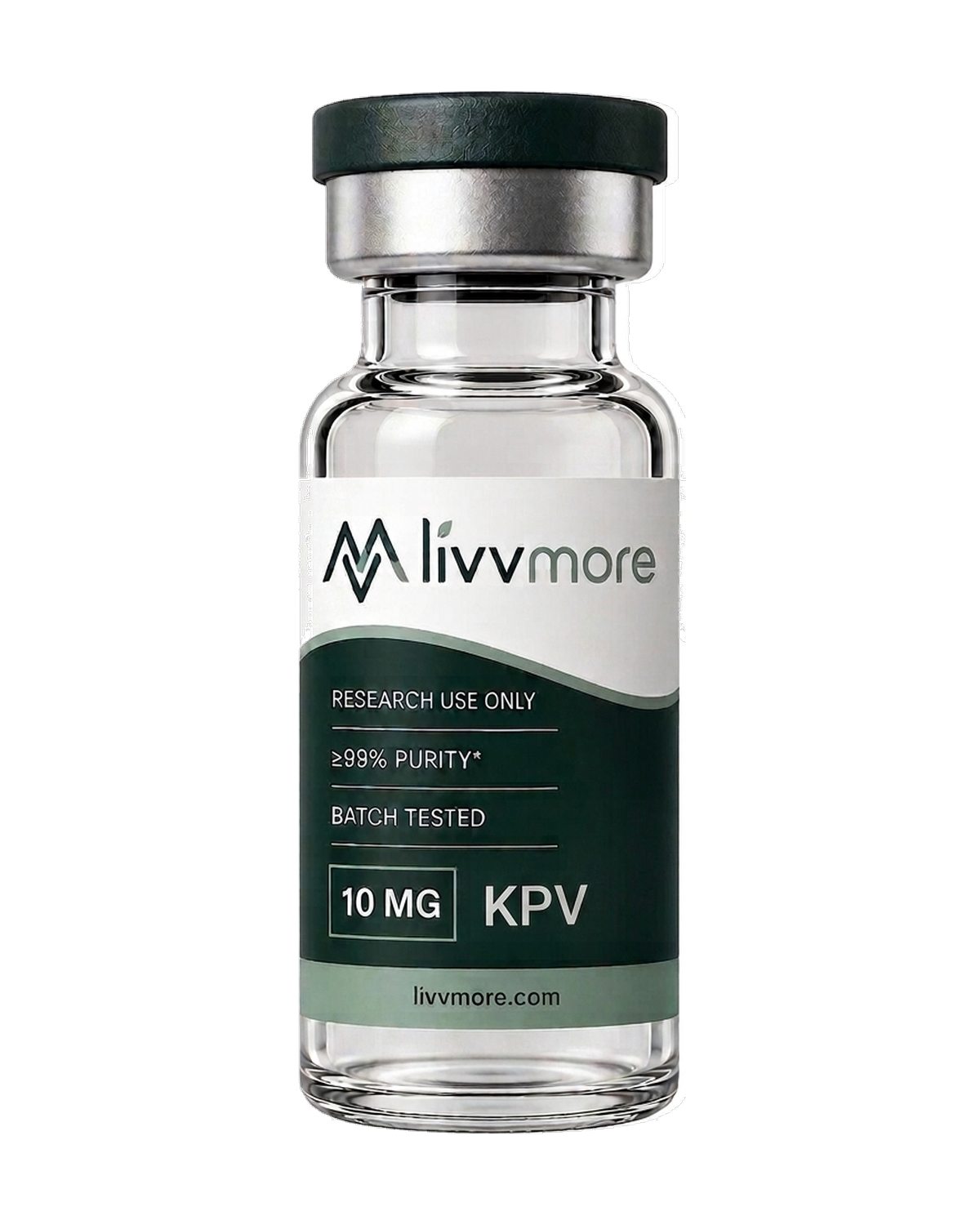
Research peptide
Lyophilized powder, catalogued by compound identity and backed by a certificate of analysis for its production batch.
Indicative · checkout opens at launch
100 in stock
Sealed, labelled vials · US delivery
| Quantity | 5–9 | 10+ |
|---|---|---|
| Discount | 10% | 15% |
| Price | $81.00 | $76.50 |
Indicative volume pricing, confirmed at launch.
View specifications Batch documentation Certificate of analysis
Documented by batch
Overview
Premium research-grade KPV for scientific and laboratory research.
KPV (Lys-Pro-Val) is a synthetic tripeptide corresponding to the C-terminal three amino acids of the endogenous melanocortin peptide α-MSH. Although it consists of only three amino acid residues, KPV has attracted considerable scientific interest because experimental studies have reported biological activity independent of the full α-MSH peptide.
Over the past several decades, KPV has become an important investigational compound in laboratory research examining immune signalling, epithelial biology, gastrointestinal physiology, skin biology, innate immune biology and peptide pharmacology.
KPV is composed of three naturally occurring amino acids, lysine, proline and valine, and may also be described in the scientific literature as α-MSH(11–13). Modern laboratory-grade KPV is produced using solid-phase peptide synthesis, followed by purification using high-performance liquid chromatography (HPLC) and analytical characterisation by mass spectrometry to confirm identity and purity.
Unlike larger melanocortin peptides that activate melanocortin receptors through the conserved His-Phe-Arg-Trp pharmacophore, KPV lacks this receptor-binding sequence. Nevertheless, laboratory investigations have reported activity within immune signalling pathways across a range of experimental models, prompting continued research into receptor-independent signalling and intracellular pathways.
This observation has made KPV an important research tool for scientists investigating peptide-mediated regulation of immune responses and epithelial homeostasis.
The peptide has become particularly important in experimental research involving intestinal epithelial biology. Several investigations have demonstrated transport of KPV through the peptide transporter PepT1, allowing researchers to study epithelial uptake mechanisms, intracellular signalling and immune responses in gastrointestinal cell models. Experimental findings have suggested modulation of NF-κB and MAPK signalling pathways under laboratory conditions, although these observations remain largely confined to cell culture and animal research.
Research involving KPV now spans multiple scientific disciplines including gastroenterology, dermatology, immunology, molecular biology, peptide chemistry, epithelial physiology and microbiology. Published investigations have examined epithelial barrier integrity, cytokine signalling, keratinocyte biology, antimicrobial activity and mucosal immune signalling in controlled laboratory settings.
At livvmore, KPV is supplied exclusively for laboratory research and scientific investigation. Every batch undergoes quality control procedures designed to verify identity, purity and consistency before release, with batch-specific Certificates of Analysis (COA) available to support research laboratories.
For laboratory research use only. Not for human or veterinary use.
Specifications
Batch documentation
Every batch is third-party tested. The batch-specific certificate of analysis is available on request; the layout below shows the fields it records.
Specimen layout. A batch-specific certificate of analysis is issued for each production run and is available on request.
Testing records
Every batch is accompanied by laboratory records. The entries below describe what each record documents.
High-performance liquid chromatography records the compound’s retention profile against a reference.
Mass spectrometry records the compound’s measured mass to document molecular identity.
The physical appearance of the material is recorded, for example a white lyophilized powder.
Each batch is logged with a lot number and production date for traceability.
These are records of laboratory testing carried out on the batch. They document compound identity for research use and are not a statement of safety, suitability, or fitness for any use.
Research information
KPV has become one of the most extensively investigated short peptides within immune signalling biology because of its reported activity in experimental models, despite lacking the classical melanocortin receptor-binding motif. Published research has primarily focused on understanding its molecular transport, intracellular signalling pathways and interactions with epithelial and immune cells under laboratory conditions. The available evidence is derived predominantly from cell culture and animal studies, while published evidence from human studies remains extremely limited.
The scientific literature surrounding KPV consists predominantly of laboratory and animal investigations. Although these studies provide valuable mechanistic insight, published evidence from human studies remains extremely limited. There are currently no large, completed randomized controlled human trials characterising its activity for any specific application. KPV therefore remains an investigational peptide supplied for laboratory research rather than an approved product.
The information presented summarises findings from the published scientific literature and is provided solely for educational and laboratory research purposes. livvmore supplies KPV exclusively for laboratory research use.
For laboratory research use only. Not for human or veterinary use.
Frequently asked questions
KPV is catalogued in the Peptide fragments collection and supplied as a white lyophilized powder for in-vitro laboratory research. It is listed by CAS number 67727-97-3 and a molecular weight of 342.43 g/mol. It is not for human or veterinary use.
The CAS number recorded for KPV is 67727-97-3.
The molecular weight recorded for KPV is 342.43 g/mol.
KPV is supplied as a white lyophilized powder. Store refrigerated at 2–8°C, protected from light and moisture. For extended storage, follow your laboratory's standard storage procedures.
All products are supplied strictly for in-vitro laboratory research and are not for human or veterinary use, diagnosis, treatment, or personal consumption.
Every batch is third-party tested and documented. The certificate of analysis is available on request.
Every batch is third-party tested, and the batch-specific certificate of analysis is available on request.
By placing an order, purchasers acknowledge that the product is intended solely for laboratory research use and agree to the Research Use Terms.
Fulfilment
Sealed, labelled research vials, packed to protect integrity in transit.
Every batch is third-party tested; the certificate of analysis is available on request.
Supplied to qualified researchers for laboratory research use.
Shipping options and timelines are shown at checkout.
More in this collection
Order
Indicative pricing · checkout opens at launch
Checkout opens at launch, once an approved payment provider is in place.
Every batch is checked against its compound identity before it is catalogued.
A US-based team on hand for catalogue, documentation and order questions.
Batch and lot records are kept for every compound, recorded not asserted.
Each batch is tested by an independent laboratory; the certificate is available on request.
Sealed, labelled research vials, packed to protect integrity in transit.
Orders are prepared and dispatched promptly.